
Internet access in Nigeria reached 109 million unique users as of October 2025, about 45.5% of the country’s roughly 239 million people, according to DataReportal’s Digital 2026 Nigeria report.
That single sentence already contains the two numbers most often confused in coverage of Nigeria’s internet: the count of people online and the count of active mobile data subscriptions, which the Nigerian Communications Commission (NCC) put at 157,405,351 as of May 2026.
Those two figures measure different things, and mixing them up is why headlines about Nigeria’s internet often look like they contradict each other.
This page separates the two cleanly, then covers broadband growth, network operators, NCC regulation, the rural-urban access gap, and data costs, with a dedicated guide linked from each section for readers who want more detail.
What internet access in Nigeria looks like right now
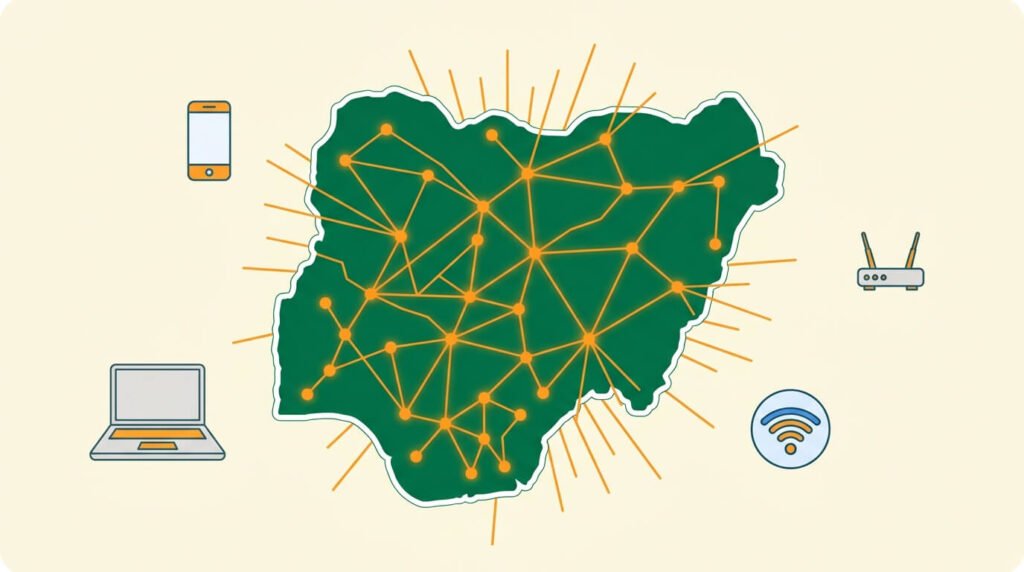
Nigeria has three overlapping but distinct numbers worth knowing before any of the rest of this page makes sense: 109 million internet users (people who go online), 157.4 million internet subscribers (active data-enabled SIM cards, since one person can carry several), and 192.23 million total active telecom subscriptions of all kinds, including voice-only lines, as of June 2026.
Overall teledensity, a measure of phone lines per 100 people, stood at 88.67% in June 2026.
Of those subscriptions, 121.64 million met the NCC’s technical definition of broadband as of May 2026, a threshold based on minimum connection speed rather than simply having a data plan, and that broadband count climbed to roughly 123.11 million by June 2026.
Each of these numbers answers a narrower question than “how connected is Nigeria,” and treating any one of them as the whole answer is how most confusion about the country’s internet statistics starts.
A quick history of how Nigeria got online
Nigeria’s internet history starts with a small cluster of dial-up internet service providers operating in the mid-1990s, running on slow, expensive satellite links and serving mostly universities, government offices, and a handful of businesses in Lagos and Abuja.
The turning point came in 2001, when the NCC auctioned GSM licenses and MTN, the operator later known as Airtel, launched mobile service that August, ending the era when the state-run NITEL controlled almost all telephone access in the country.
That same period saw Nigeria connect to the SAT-3/WASC submarine cable, its first major international bandwidth link that did not depend on satellite.
A second wave of cables, including Glo-1 and MainOne in 2010 and WACS in 2012, added enough capacity to make the smartphone-era data boom of the 2010s possible.
Internet users vs. internet subscribers: the number that trips everyone up
DataReportal’s 109 million users and the NCC’s 157.4 million subscribers are not two estimates of the same thing arrived at differently.
They are answers to two different questions, and the gap between them is almost entirely explained by how many SIM cards the average Nigerian mobile user carries.
| Metric | Figure | Source | What it measures |
|---|---|---|---|
| Internet users | 109 million | DataReportal, Digital 2026: Nigeria (October 2025) | Unique people who access the internet, regardless of how many devices or SIMs they use |
| Internet subscribers | 157,405,351 | NCC (May 2026) | Active data-enabled SIM subscriptions, counted per SIM, not per person |
| Broadband subscriptions | 121,643,718 | NCC (May 2026) | Subscriptions meeting the NCC’s minimum broadband speed threshold |
| Total active telecom subscriptions | 192.23 million | NCC (June 2026) | All active lines, voice and data combined |
If a question asks how many Nigerians are online, DataReportal’s user figure is the right one to cite. If a question asks how many active data connections or lines exist in the country, the NCC’s subscriber figure is the right one.
Neither number is wrong; they answer different questions, and a lot of Nigerian tech coverage cites one while implying the other.
Why one person can count as three subscribers
Multiple SIM ownership is common in Nigeria for reasons that have little to do with how many people are online.
Many users keep a second or third SIM to take advantage of promotional data bundles that rotate between MTN, Airtel, Glo, and 9mobile, since each carrier periodically offers cheaper rates, making it worth switching data usage to whichever network has the best deal that month.
Others carry a backup SIM because network quality varies by location, and a line that works well at home may drop out at the office.
Businesses also register separate lines for staff devices, routers, and point-of-sale terminals, each of which counts as its own subscription in NCC data even though it does not represent an additional person.
None of this changes the size of Nigeria’s actual online population; it changes how large the subscription count looks relative to it.
Internet penetration rate in Nigeria
Nigeria’s internet penetration rate, the share of the total population that uses the internet, stood at 45.5% as of October 2025, up from 43.2% a year earlier, an increase of about 2.5 million users.
That gain reflects steady but not explosive growth: Nigeria added roughly the population of a mid-sized city to its online population over twelve months, a pace that keeps pushing penetration upward without closing the gap with more connected markets quickly.
A full breakdown of how this rate has shifted year by year, and how it compares across Nigerian states, is covered in the dedicated guide to the internet penetration rate in Nigeria.
How penetration has moved year over year
- October 2024: internet penetration measured 43.2% of the population, based on the prior year’s DataReportal report.
- October 2025: penetration reached 45.5%, a gain of roughly 2.3% year over year and about 2.5 million additional users.
- Broadband penetration specifically moved from 48.01% in July 2025 to 56.11% by May 2026, then to 56.79% by June 2026, a faster pace of growth than the overall user penetration rate because it reflects existing subscribers upgrading to broadband-grade connections rather than new people coming online for the first time.
- Total active telecom subscriptions rose from 189.68 million in May 2026 to 192.23 million in June 2026, a monthly gain of about 2.55 million lines.
Broadband subscribers and internet service providers
Broadband subscriptions in Nigeria reached 121,643,718 as of May 2026, putting broadband penetration at 56.11%, and that figure climbed further to about 123.11 million subscriptions, or 56.79% penetration, by June 2026.
Four licensed mobile network operators carry almost all of that traffic, with MTN Nigeria holding the largest share by a wide margin.
A full breakdown of subscriber counts by operator and by state is available in the dedicated guide to broadband subscriber numbers in Nigeria.
Market share by operator
| Operator | Active subscriptions (June 2026) | Market share |
|---|---|---|
| MTN Nigeria | 98.64 million | 51.38% |
| Airtel | 66.12 million | 34.44% |
| Globacom | 23.68 million | 12.34% |
| 9mobile | 3.54 million | 1.84% |
MTN and Airtel together account for more than 85% of all active subscriptions, which means the health of Nigeria’s internet infrastructure is closely tied to how well those two networks maintain and expand their coverage.
Network technology: how Nigerians connect
- 4G connections make up 54.31% of active mobile connections, the dominant technology for everyday browsing, streaming, and app use.
- 2G connections still account for 36.22% of the network, reflecting how many users, particularly outside major cities, rely on older feature phones or areas where newer infrastructure has not been deployed.
- 3G connections hold 4.86% of the mix, a shrinking middle tier as operators phase out older equipment in favor of 4G.
- 5G connections stand at 4.61%, still concentrated in select urban areas and largely limited to newer smartphones and fixed-wireless home internet plans.
National or state-level statistics like these describe averages across an entire operator’s network, but they say nothing about whether a specific street, estate, or building gets a usable signal from that operator, which is exactly the gap Arandmi is built to close by letting residents rate real internet and power reliability area by area so a house hunter can check a location before signing a lease.
How the NCC regulates the internet in Nigeria
The Nigerian Communications Commission is the government body responsible for licensing internet service providers, setting quality-of-service standards, and issuing rules that govern how online platforms operate inside Nigeria.
Its authority covers both the telecom operators that carry internet traffic and, under newer rules, the digital platforms that run on top of that traffic.
A full walkthrough of what the NCC requires of providers and platforms, and how those rules have changed recently, is covered in the dedicated guide to NCC’s internet regulations.
What the Internet Code of Practice requires
- Licensed Internet Access Service Providers and covered online platforms must maintain content moderation tools capable of responding to harmful or illegal material.
- Platforms must comply with the Nigeria Data Protection Act 2023, including notifying the National Data Protection Commission of a data breach within 48 hours of discovery.
- Covered providers must submit compliance reports to the NCC twice a year rather than on an ad hoc basis.
- Providers must operate within an NCC cybersecurity framework and disclose how they manage network traffic, so that any prioritization or throttling of certain traffic types is documented rather than hidden.
- The NCC ended the sale of pre-registered SIM cards in November 2025 and tightened Quality of Service rules in January 2026, both aimed at reducing fraud and improving network reliability.
The Code of Practice itself remains under review, and in July 2026 Nigeria paused parts of its internet-platform rules while it works toward a single, unified digital policy rather than several overlapping frameworks, so providers and platforms should expect further changes rather than treating the current rules as final.
The rural-urban internet access gap
Internet access in Nigeria is far from evenly distributed: rural communities have internet access at a rate of only 23%, compared with 57% in urban areas, a 34-percentage-point gap disclosed by NCC Executive Vice Chairman Dr. Aminu Maida at the Rural Connectivity Summit in Lagos on October 22, 2025.
That gap is one of the main reasons Nigeria’s national broadband target has been difficult to hit even as urban penetration climbs.
A closer look at which states and regions are hit hardest, and what is being done about it, is covered in the dedicated guide to rural internet access in Nigeria.
- A 2022 study identified 97 unserved and underserved community clusters across Nigeria, representing about 27.91 million people with no meaningful telecom access at all.
- Closing that gap is estimated to require about $461 million in infrastructure investment, funded in large part through the Universal Service Provision Fund (USPF), which draws mandatory contributions from licensed telecom operators to subsidize rollout in areas the market alone will not reach profitably.
- The National Broadband Plan covering 2020 to 2025 set a target of 70% broadband penetration by the end of 2025; actual penetration ran between roughly 48.81% and 50.58% through late 2025 before rising to 56.79% by June 2026, meaning the target was missed by a wide margin even as the trend line continues upward.
Why rural connectivity lags so far behind
- Fiber cuts damaged network infrastructure more than 19,000 times between January and August 2025 alone, often from road construction or third-party excavation work that severs buried cable.
- Equipment theft and vandalism affected base stations and related infrastructure more than 3,000 times over the same period, with rural and semi-rural sites often targeted because they are harder to secure than urban ones.
- Right-of-Way fees charged by some state governments for laying fiber along roads remain high enough to discourage rollout in less profitable areas, even though 11 states now waive these fees entirely to attract investment.
- Diesel and other energy costs for running base stations off-grid or during power outages add a recurring operating expense that makes rural sites less commercially attractive than urban ones.
- Limited last-mile infrastructure, meaning the final stretch of cable or wireless connection that reaches individual homes and businesses, remains the most expensive part of any rural rollout relative to the number of paying customers it can reach.
How much data Nigerians use and what it costs
Nigerians used 1,532,172.67 terabytes of mobile data in June 2026 alone, up from 1,504,067.36 terabytes in May, bringing the first half of 2026 to a combined total of roughly 8.51 million terabytes.
On a per-subscriber basis, MTN Nigeria reported average usage of 14.8GB per month in the first half of 2026, up 15.2% from the same period a year earlier.
A detailed breakdown of usage by state, by operator, and typical data plan pricing is covered in the dedicated guide to how much internet data Nigerians use.
What is driving data consumption higher
Rising per-subscriber usage tracks closely with the shift toward 4G connections, since faster networks make video streaming, social media, and app downloads practical in ways that were not on 2G and 3G.
Cheaper smartphones entering the market have also put data-capable devices in the hands of users who previously relied on basic feature phones limited to calls and texts.
Streaming platforms, mobile banking, and remote work tools have all become more central to daily life in Nigeria over the past few years, and each of those uses pulls more data per session than the messaging and browsing habits that defined earlier years of mobile internet use in the country.
Why internet access matters for Nigeria’s economy
Broadband access has a measurable link to economic output in Nigeria, with a widely cited estimate holding that every 10-percentage-point rise in broadband penetration can lift GDP by up to 1.38%.
That relationship is part of why the National Broadband Plan set an explicit penetration target rather than treating internet rollout as a side effect of general telecom growth, and it is also why the gap between urban and rural access matters beyond convenience.
Areas without reliable internet are largely locked out of digital services, online commerce, and remote work opportunities that broadband access enables elsewhere in the country, which means the rural-urban gap covered above is also an economic gap between the areas that can participate in that growth and the areas that cannot.
With broadband penetration at 56.79% as of June 2026 and still short of the 70% target the NCC continues to describe as its primary objective, Nigeria’s next broadband plan, not yet confirmed, will need to address the specific infrastructure and cost barriers covered above rather than simply restating the same target on a new timeline.
Small businesses that depend on mobile banking, online marketplaces, or basic customer communication tools feel this gap directly: a shop in an area with unreliable data access loses hours of transaction time every week compared with a shop in an area with steady coverage.
Nigeria’s internet numbers make more sense once the sources are kept straight: DataReportal counts people, the NCC counts subscriptions, and neither is measuring penetration the way a household survey would.
The sections above link out to five deeper guides covering penetration trends, broadband subscriber data, NCC regulation, rural access, and data costs in more detail than a single overview page can hold.
The four questions below cover the ones readers ask most often once they have the basic picture.
Frequently asked questions
How many people use the internet in Nigeria?
As of October 2025, 109 million people in Nigeria used the internet, about 45.5% of the country’s population of roughly 239 million, according to DataReportal’s Digital 2026 Nigeria report.
This figure counts unique individuals rather than devices or SIM cards, which is why it is lower than the NCC’s subscriber count of 157.4 million active data SIMs reported in May 2026.
The user figure grew by about 2.5 million people, or 2.3%, compared with the October 2024 measurement, showing steady rather than sudden growth in Nigeria’s online population.
Why do internet user and subscriber numbers not match?
Internet user figures from DataReportal count individual people, while the NCC’s subscriber figures count active data-enabled SIM cards, and one person commonly owns two or three SIMs across MTN, Airtel, Glo, and 9mobile.
Nigerians often keep multiple lines to access rotating promotional data bundles, maintain a backup connection where one network has weak coverage, or register separate SIMs for business devices and personal use.
Because each SIM counts as its own subscription regardless of who owns it, the subscriber total will always run well above the actual number of people using the internet.
Has Nigeria met its national broadband target?
No. The National Broadband Plan covering 2020 to 2025 set a target of 70% broadband penetration by the end of 2025, and actual penetration reached only about 48.81% to 50.58% through late 2025 before climbing to 56.79% by June 2026.
The shortfall is largely attributed to fiber cuts affecting infrastructure more than 19,000 times between January and August 2025, equipment theft and vandalism, high Right-of-Way fees charged by some state governments, and the cost of powering base stations in areas without reliable electricity.
The NCC still describes 70% penetration as its primary objective, though no confirmed successor plan with a new target date has been announced.
Which internet provider has the most users in Nigeria?
MTN Nigeria holds the largest share of active telecom subscriptions, with 98.64 million subscriptions as of June 2026, equal to 51.38% of the market.
Airtel follows with 66.12 million subscriptions (34.44%), Globacom holds 23.68 million (12.34%), and 9mobile holds 3.54 million (1.84%).
MTN and Airtel together account for more than 85% of all active connections in the country, meaning coverage and reliability on those two networks largely determine what internet access looks like for most Nigerians, whatever their state or city.
6 Responses