
Fibre internet in Nigeria exists at national scale but not at household scale. The country has laid roughly 101,000 kilometers of fibre-optic backbone cable, yet only about 265,000 homes are connected through Fibre-to-the-Home (FTTH) service.
Most of the 123.11 million broadband connections in Nigeria as of June 2026 run on mobile 3G, 4G, or 5G data, not on a fibre line into the house.
So when someone says “fibre is available in Lagos” or “fibre is coming to my state,” that usually describes a cable passing somewhere nearby, not a service you can order for your specific address.
What counts as fibre internet in Nigeria
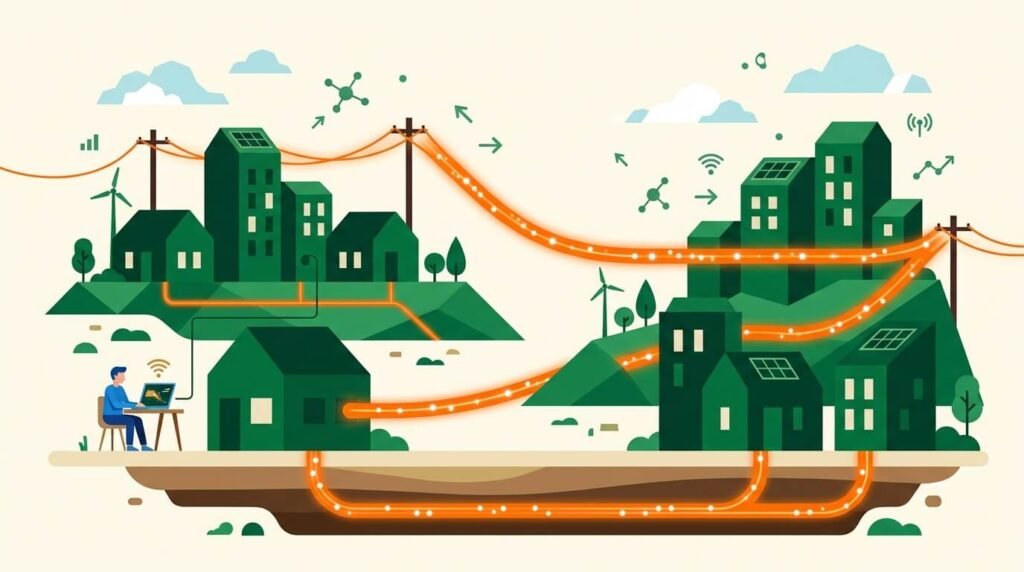
Fibre internet is not one single thing in Nigeria, and the terminology gets mixed up often enough that it’s worth separating.
Backbone fibre is the long-haul cable that carries data between cities and states, owned by companies like MainOne, Globacom (through Glo-1), and infrastructure players like IHS Nigeria.
This is the 101,000km figure. FTTx is the broader category of fibre-based last-mile technologies, including FTTH (fibre run directly into a home) and FTTB (fibre to a building, with copper or wireless handling the final stretch to individual units).
When a provider markets “fibre internet” in Nigeria, it usually means FTTH or FTTB, delivered by an internet service provider that has built or leased local distribution fibre in a specific neighborhood, not the national backbone itself.
A street can sit two kilometers from a backbone trunk and still have zero fibre-based home internet options, because nobody has built the last-mile connection to reach the houses on that street.
The paradox: a national backbone that bypasses its own people
Nigeria has one of the more extensive fibre backbones on the continent by raw kilometers, but that scale has not translated into home connections.
A BusinessDay investigation found that although Nigeria has deployed more than 101,000 km of fibre-optic backbone, about 130 million Nigerians still lack mobile internet—evidence that the infrastructure exists, but last‑mile connections to homes and communities largely do not.
The numbers behind the paradox:
- Fibre-optic backbone in place: roughly 101,000 kilometers
- Homes connected via FTTH nationally: approximately 265,000
- Total broadband subscriptions (mostly mobile): about 123.11 million, or 56.79% penetration, as of June 2026
- Nigerians the backbone reportedly bypasses, per BusinessDay’s reporting: 130 million
Nigeria ranks below the African average on home fibre connectivity despite having built more physical cable than most countries on the continent.
The gap between what’s buried and what’s plugged into a router is the story this entire article is built around.
Why fibre is cheap under the sea and expensive on land
Building fibre capacity under the ocean is, relatively speaking, the easy part. Extending that same fibre from a landing station to an actual house in Nigeria is where the cost and complexity multiply.
Nigeria hosts several major international submarine cables at its coast, including SAT-3/WASC (2001), Glo-1 (2010, owned by Globacom), MainOne (2010), WACS (2012), ACE, and the newer 2Africa cable, whose Core 2Africa System was completed in November 2025 and lands in Nigeria and Ghana via Bayobab.
Cumulative investment at Nigerian landing points has been estimated at around $9.7 billion, and Nigeria is reportedly in advanced talks with Google about an additional subsea cable, alongside separate discussions with Equatorial Guinea on another undersea project.
The economics of these two layers of fibre are almost opposite.
| Factor | Submarine (undersea) fibre | Terrestrial (on-land) fibre |
|---|---|---|
| Typical cost | $20,000 to $45,000 per kilometer | Part of a $1.5 to $2 billion build for ~90,000 km, far higher per km on average |
| Cost model | Standardized international consortium builds, costs shared across countries | Built and financed largely per operator, per route |
| Main cost drivers | Cable manufacturing, ship-laying, landing station equipment | Right-of-way fees, repeated vandalism, permits, security, duplicated routes |
| Predictability | High; global consortium contracts follow known templates | Low; costs vary by state, by local government, and by road |
| Who typically pays | Multinational consortiums (telcos, Meta, Google) | Individual Nigerian ISPs and infrastructure companies |
In short, the cable that crosses an ocean is cheaper per kilometer to build and share than the cable that has to cross a Nigerian state.
That inversion is the single biggest reason international bandwidth into Nigeria has grown steadily while home fibre connections have not.
The real barriers keeping fibre off Nigerian streets
Extending fibre from a backbone trunk to a residential street in Nigeria runs into a specific, well-documented set of obstacles, and none of them are about the cable itself being hard to manufacture.
Right-of-way fees and state-by-state inconsistency
Right-of-way (RoW) fees are charges state governments levy on companies laying cable along roads within their territory.
The Nigerian Communications Commission (NCC) recommends a rate of ₦145 per meter, but adoption of that rate is inconsistent across the federation.
As of 2026, 13 states have waived RoW fees entirely, while 16 states charge the recommended rate, and the rest negotiate their own terms, often per meter rather than per plot or project.
Bayo Juba of IHS Nigeria has noted that securing right-of-way “often takes a long time, which adds costs and delays construction.”
For an ISP planning a route that crosses multiple local government areas or state lines, that inconsistency turns a straightforward engineering project into a drawn-out negotiation with unpredictable pricing at every border.
Fibre cuts and vandalism
Even fibre that gets built doesn’t stay intact. Nigeria recorded more than 27,685 fibre cut incidents across the industry in 2025, plus around 27,000 access-denial incidents where operators were blocked from reaching their own infrastructure for repairs.
MTN alone logged 9,218 cuts in a single year, averaging more than 25 a day.
Most of these cuts come from road construction crews, diggers, and other third-party excavation work that severs buried cable, and there is generally no compensation mechanism forcing the party responsible to pay for the damage.
Every cut means a repair crew, a repair cost, and downtime for every customer on that line, which discourages ISPs from extending fibre into areas where road works are frequent and uncoordinated.
Duplicated infrastructure
Instead of sharing ducts or poles, multiple fibre operators frequently lay separate cable along the same road at different times.
This duplication multiplies the total capital spent on a given route without adding any new coverage, since the same houses could have been served by one shared line instead of three competing ones.
It’s a structural inefficiency that comes from a market where infrastructure sharing is not consistently enforced or incentivized.
Taxes, community demands, and power supply
Beyond RoW fees, ISPs building terrestrial fibre routes also face multiple, sometimes overlapping tax obligations from different tiers of government, ad hoc compensation demands from communities along the route, and security risks in areas where equipment theft is common.
Power supply adds another layer of cost, since network equipment along a fibre route needs a reliable electricity source, and that reliability varies unpredictably from one location to the next.
None of these costs show up in a map of where the backbone runs, but all of them factor into whether an ISP decides a given street is worth connecting.
None of these barriers show up on a national coverage map, and the only way to know whether they have actually been overcome on one specific street is ground-level reporting from people who already live there, which is exactly what Arandmi lets residents provide by rating real internet and power reliability address by address.
Who actually offers fibre internet in Nigeria right now
A handful of providers account for most of the fibre and FTTH capacity reaching Nigerian homes today, and each has a distinct footprint and focus.
| Provider | Known for |
|---|---|
| MTN FibreX | MTN’s fixed fibre product, added about 125,000 users in a year, live in 15 states across 232 locations, though 77.6% of those locations sit in Lagos, Rivers State, and the FCT alone |
| Spectranet | The largest dedicated fixed ISP in Nigeria, with roughly 115,000 subscribers, offers both fixed wireless and fibre and grew through a 2025 merger with Legend Internet |
| ipNX | A premium terrestrial fibre provider, offers Nigeria’s first 1 Gbps residential fibre plan, with a median measured speed around 37.78 Mbps across its customer base |
| Tizeti | Over 2.5 million users, runs solar-powered infrastructure, entry-level fibre plans typically priced around ₦15,000 to ₦25,000 per month |
| FibreOne | A smaller but fast-growing operator, with roughly 18% network expansion over the past year |
None of these providers cover the whole country, and coverage inside a single city can still vary block by block depending on where each operator has run distribution fibre.
Where fibre is growing, and where it still isn’t
Fibre subscriber numbers in Nigeria are climbing, just from a small starting point.
One recent three-month window added about 80,000 FTTx subscribers nationally, and Q2 2026 alone added roughly 78,000 fibre users, both signs that growth is real even if the base is still tiny relative to the population.
The problem is where that growth is concentrated. MTN FibreX, one of the fastest-growing fibre products in the market, has 77.6% of its 232 locations sitting not just in three states ( Lagos, Rivers State, and the FCT) but gradually rolling into other states:
That pattern holds broadly across the industry, not just for MTN, meaning fibre growth is largely a story about a handful of major cities getting better served while everywhere else waits.
This concentration lines up with a broader access split the NCC has documented directly. Dr. Aminu Maida, the NCC’s Executive Vice Chairman, told the Rural Connectivity Summit in Lagos on October 22, 2025, that rural areas have only about 23% internet access compared to 57% in urban areas.
Nigeria’s National Broadband Plan (2020-2025) had targeted 70% broadband penetration by the end of 2025; actual penetration reached only about 48.81% to 50.58% through late 2025, climbing to 56.79% by June 2026, still short of the original goal and driven mostly by mobile data rather than fibre.
Fibre concentration in a few cities does not just reflect the urban-rural gap; it actively reinforces it, since fibre investment keeps flowing to the same handful of profitable, high-density locations rather than spreading toward areas with lower population density and higher rollout costs.
What this means if you’re checking an address for fibre
If you’re trying to figure out whether fibre internet will work at a specific address in Nigeria, the honest answer is that national statistics and provider marketing pages will not tell you.
A city being listed as covered by MTN FibreX, Spectranet, ipNX, Tizeti, or FibreOne means the provider has infrastructure somewhere in that city, not that your specific street has a live connection point.
The only way to know for certain is to check directly with providers for your address, ask neighbors or people already living on the street what speeds and reliability they get in practice, and treat “coverage area” claims as a starting point for inquiry rather than a guarantee.
For a fuller picture of how fibre fits into the national connectivity story, see the wider picture of connectivity in Nigeria, which covers mobile data, satellite options, and the overall broadband market alongside fibre.
If you’re comparing options beyond fibre specifically, which providers offer the best fibre and broadband plans breaks down pricing and service quality across the market.
The concentration pattern described above also feeds into the deeper access gap this creates between connected and unconnected Nigerians, and if you’re located outside a major city, the rural access gap covers what options actually exist once you’re outside the handful of areas fibre operators have prioritized.
Frequently asked questions
Is fibre internet available everywhere in Nigeria?
No. Fibre internet in Nigeria is concentrated in a small number of cities and neighborhoods, primarily Lagos, Rivers State, Abuja (FCT), and gradually rolling out into other cities and states.
Even within those cities, coverage can vary from one street to the next depending on which provider has built distribution fibre there.
Nationally, only about 265,000 homes are connected via FTTH, a small fraction of Nigeria’s total households, despite the country having roughly 101,000 kilometers of fibre backbone cable already in the ground.
Why is fibre internet so expensive to extend to new areas in Nigeria?
Terrestrial fibre rollout in Nigeria faces right-of-way fees that vary by state, with the NCC’s recommended rate at ₦145 per meter but adoption inconsistent across the country.
On top of that, Nigeria recorded more than 27,685 fibre cut incidents in 2025, mostly from uncoordinated road construction, with no standard compensation mechanism for the damage.
Add multiple tax layers, community compensation demands, security risks, and unreliable power supply along many routes, and the cost of extending fibre inland becomes far higher and less predictable than building submarine cable capacity offshore.
What is the difference between FTTH and mobile broadband in Nigeria?
FTTH, or Fibre-to-the-Home, means a physical fibre-optic cable runs directly into your house or building, typically delivering faster and more consistent speeds than wireless options.
Mobile broadband, delivered over 3G, 4G, or 5G networks, accounts for the large majority of Nigeria’s roughly 123.11 million broadband subscriptions as of June 2026.
Mobile data is more widely available since it does not require a physical last-mile cable to each home, but it is generally more sensitive to network congestion and distance from a cell tower than a dedicated fibre line.
How do I know if fibre will work well at a specific address in Nigeria?
Provider coverage maps and marketing claims describe general service areas, not guaranteed performance at one specific building or street.
The most reliable approach is to contact providers directly for that exact address, ask people already living nearby about their real experience with speed and uptime, and treat any coverage claim as something to verify rather than assume.
Given how unevenly fibre has been deployed, even inside cities that are technically “covered,” checking real, address-level reliability before committing to a lease or purchase can save significant frustration later.
4 Responses