
Internet data is expensive in Nigeria because the cost of running a telecom network has climbed faster than the price of data itself for over a decade.
A depreciating naira makes imported base stations, routers, and fibre cable cost more in local currency.
Diesel to power cell sites where grid electricity fails adds another recurring cost. Multiple levies from federal, state, and local agencies, inconsistent right-of-way charges for laying fibre, and thousands of fibre cuts each year all raise operating costs that get passed on to subscribers.
The 50 percent tariff increase the Nigerian Communications Commission approved in January 2025, the first in twelve years, made this visible almost overnight.
Still, it was catching up to costs that had already been building since 2013.
Why Is Internet Data Expensive in Nigeria? What drives the Cost?
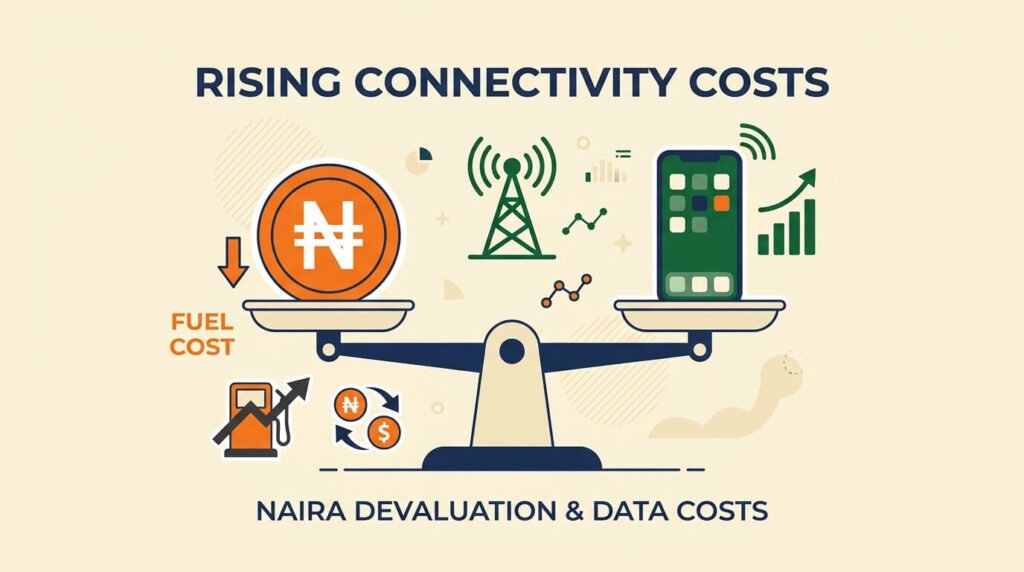
Nigerian data prices sit at the point where several separate cost pressures meet at once, not a single cause.
Telecom operators buy most of their network hardware in US dollars while earning revenue in naira, so every naira depreciation event effectively raises their capital costs without a single price being changed on paper.
On top of that, operators must self-generate a large share of the power that runs their base stations because the national grid is unreliable in many areas, and diesel is not cheap.
Layered on top of both are taxes, permits, and right-of-way charges that vary by state, plus the ongoing cost of repairing fibre lines cut by construction crews, vandals, or thieves. The main drivers are:
- Naira devaluation, which raises the naira cost of dollar-denominated network equipment and spectrum-related expenses.
- Diesel dependency at cell sites that lack stable grid electricity.
- Multiple taxation from overlapping federal, state, and local government levies.
- Inconsistent right-of-way fees charged by different states for laying fibre.
- Fibre cuts and infrastructure vandalism that force constant repair spending.
- A 12-year regulatory price freeze that delayed cost pass-through until 2025.
The 2025 tariff hike explained the pressure; it did not create it
The January 2025 tariff increase raised the price ceiling operators could charge; it did not invent the underlying costs that made the increase necessary.
On 29 January 2025, the NCC approved a 50 percent increase in regulated telecom tariffs, the first adjustment since 2013.
Operators phased the new rates in from February 2025. The regulator and the GSMA framed the move as necessary to enable over 150 million dollars in additional network investment and to help expand 4G coverage from 90 percent to 94 percent of the population.
The table below shows how the regulatory benchmark rates changed. These are ceiling figures the NCC uses for regulation, not the exact retail price of every bundle, since actual plan prices vary by operator and package size.
| Service | Pre-2025 benchmark rate | Post-2025 benchmark rate |
|---|---|---|
| Voice calls | N6.40 per minute | N9.60 per minute |
| SMS | N4 per message | N6 per message |
| 1GB data | N287.50 | N431.25 |
Read the 2025 tariff hike for a full breakdown of how the increase was rolled out and how it compared across operators.
Naira devaluation and the real cost of imported network equipment
A base station, a router, or a backup generator does not become more expensive to manufacture just because the naira weakens, but it becomes more expensive to buy in Nigeria.
Almost all core network hardware, from radio equipment at cell towers to fibre optic cable and the generators that back them up, is priced in US dollars because Nigeria does not manufacture this equipment domestically.
When the naira loses value against the dollar, an operator needs more naira to buy the same imported item it bought the year before, even if the dollar price never moved.
That cost shows up on the balance sheet as a straightforward increase in capital expenditure, and operators recover it over time through the prices they charge subscribers.
This is one reason cost pressure had been building well before the 2025 hike was ever announced.
Diesel dependency: powering cell sites without reliable grid power
Cell sites need power around the clock, and Nigeria’s grid cannot guarantee that in most locations, so operators run diesel generators to fill the gap.
A large share of the country’s base stations run partly or fully on diesel because grid supply is inconsistent or absent in the areas they serve.
Diesel is a volatile, import-linked cost, and when diesel prices rise, that increase feeds directly into an operator’s monthly operating expense for every site that depends on it.
Unlike a one-time equipment purchase, diesel is a recurring cost that never goes away as long as the grid stays unreliable, which makes it one of the more stubborn line items behind the price of a data bundle.
Multiple taxation and regulatory levies on operators
Operators do not pay one tax to one authority; they pay a stack of fees to federal, state, and local government bodies that often overlap.
Beyond NCC license fees and VAT, telecom companies face a patchwork of state and local government levies, permits, and charges that the Association of Licensed Telecom Operators of Nigeria, ALTON, has repeatedly described as multiple taxation.
Each additional levy adds to the cost of running or expanding a network, and because these charges are not centrally coordinated, an operator can face a materially different tax burden in one state compared to another for delivering the same service.
That unpredictability makes it harder for operators to plan network expansion and easier to justify passing costs on to subscribers.
Right-of-way fees and the state-by-state inconsistency
Laying fibre cable under a road or along a right-of-way requires state government approval, and what that approval costs depends entirely on which state you are in.
The NCC recommends a right-of-way rate of N145 per meter, but adoption of that rate has been inconsistent across the country. As of 2026, the picture looks like this:
| State right-of-way status | Number of states |
|---|---|
| Waived right-of-way fees entirely | 13 |
| Charging the NCC-recommended rate (N145/meter) | 16 |
| Charging above the recommended rate | Remaining states |
A state that waives right-of-way fees makes fibre expansion cheaper and faster in that state.
A state that charges well above the recommended rate discourages operators from extending fibre there, or forces them to recover that higher cost from customers in that state.
This inconsistency is one reason data quality and pricing can differ noticeably from one part of the country to another, which is also why checking local conditions before committing to an address matters more than looking at a national average.
Fibre cuts and vandalism: an invisible tax on your bundle
Every time a fibre line is cut, whether by a construction crew, a vandal, or a thief targeting cable for scrap, an operator has to spend money and time fixing it instead of expanding coverage.
Nigeria recorded more than 27,685 fibre cut incidents nationally in 2025. MTN alone recorded 9,218 cuts that year, averaging more than 25 cuts a day.
Each repair pulls technicians and budget away from new infrastructure and toward fixing what already existed, and that repair spending is recovered through the prices operators charge.
Fibre cuts rarely make headlines the way a tariff increase does, but the repeated cost of repairing damaged infrastructure is a steady, largely invisible contributor to what subscribers pay.
None of these national cost drivers tell you whether the specific street you are considering gets a connection worth what you would pay for it, which is why Arandmi lets residents rate real internet and power reliability address by address so you can check that before signing a lease.
Cheap in dollars, expensive in real terms
Nigerian data is often cited as cheap when measured in raw US dollars against other countries, and on paper that is true, but the dollar comparison hides the more useful question of affordability.
Affordability asks what a gigabyte of data costs relative to what people earn, not what it costs on an exchange-rate spreadsheet.
Across Sub-Saharan Africa, the average cost of 1GB of data is often cited at around 5.8 percent of average monthly income, well above the UN Broadband Commission’s “1 for 2” target of 2 percent of monthly income for data to be considered affordable.
Nigeria sits inside this same regional affordability gap, facing the same pressure as its neighbors even where the sticker price looks low in dollar terms.
A low headline price and a heavy real burden can both be true at the same time, and for most Nigerian households, it is the second one that determines how much data they can afford to buy each month.
Nigerians are paying more and using more, not less
If higher prices were simply pricing people out of data, average consumption would be falling, and it is not.
Average data usage per subscriber rose 30.91 percent year over year between May 2024 and May 2025, and total monthly usage kept climbing into 2026.
| Period | Average usage per subscriber | Total monthly usage |
|---|---|---|
| May 2024 | 7.37GB | 771,993.56 terabytes |
| May 2025 | 9.86GB | 1,043,431.98 terabytes |
| June 2026 | 14.8GB | 1,532,172.67 terabytes |
Nigeria consumed roughly 4 billion gigabytes of data in the first quarter of 2026 alone, a new national record.
Total active telecom subscriptions reached 192.23 million by June 2026, a teledensity of 88.67 percent, while broadband subscriptions reached about 123.11 million, or 56.79 percent penetration, up from 48.01 percent in July 2025.
Subscribers are responding to higher prices by switching plans and buying larger bundles rather than cutting usage, which suggests data has become a fixed necessity that households budget around rather than a discretionary expense they can easily reduce.
For a closer look at how much data Nigerians actually use and how that usage breaks down by activity, see our dedicated guide.
Understanding why data costs what it does across Nigeria’s internet market as a whole is only half the picture, since price and actual service quality do not always move together on any given street.
It also helps to see how mobile data and fixed broadband pricing compare before deciding which type of connection fits your budget and location.
Frequently asked questions
Is Nigerian data cheap compared to other countries?
In raw US dollar terms, yes, Nigerian data bundles are often cited among the lower-priced options globally, which is why the country sometimes appears on lists of affordable data markets.
That comparison, however, does not account for local income levels.
When cost is measured against what an average Nigerian earns rather than against a foreign currency benchmark, the burden looks much heavier, placing Nigeria within a Sub-Saharan African region where the average cost per gigabyte still exceeds international affordability targets.
Did the 2025 tariff hike cause the high cost of data?
The 2025 tariff hike raised prices, but it did not create the underlying cost pressure behind them.
Regulated tariffs had been frozen since 2013, so costs from naira devaluation, diesel price inflation, multiple taxation, and infrastructure repair had been accumulating for twelve years without a corresponding price adjustment.
The January 2025 increase, approved by the NCC, is better understood as a delayed catch-up to those accumulated costs than as a standalone decision to raise prices.
Why do data prices differ so much between Nigerian states?
Right-of-way charges for laying fibre cable are set independently by each state government rather than by a single national rate, and that inconsistency carries through to network cost and coverage.
As of 2026, 13 states have waived right-of-way fees entirely, 16 charge the NCC-recommended rate of N145 per meter, and some states charge well above that recommended rate.
States with lower or waived fees tend to see faster fibre rollout and more competitive pricing, while states with higher fees can see slower expansion and higher costs passed through to local subscribers.
Will data prices in Nigeria come down in the future?
A reduction is unlikely as long as the underlying cost drivers stay in place, since diesel dependency, naira exchange rate pressure, multiple taxation, and fibre vandalism have not been resolved.
What could ease pricing pressure over time includes more consistent right-of-way policy across states, improved grid electricity that reduces reliance on diesel generators, and stronger enforcement against infrastructure vandalism, all of which the NCC and ALTON have flagged as priorities.
Barring major currency stabilization or infrastructure investment, prices are more likely to track cost inflation than to fall.
One Response