
Rural internet access in Nigeria is just 23%, compared to 57% in urban areas, a gap the Nigerian Communications Commission (NCC) disclosed in October 2025.
That 34-percentage-point split means the national broadband figures reported in the news, hovering around 48.81% in late 2025 and rising to 56.79% by June 2026, describe a country that barely resembles what someone living in a rural town experiences day to day.
If you are researching internet in Nigeria before moving somewhere outside a major city, the national average will tell you almost nothing useful about your own street.
This article breaks down the real numbers, the reasons rural areas lag, and what is being done, and not done, to close the gap.
How much internet access do rural areas have?
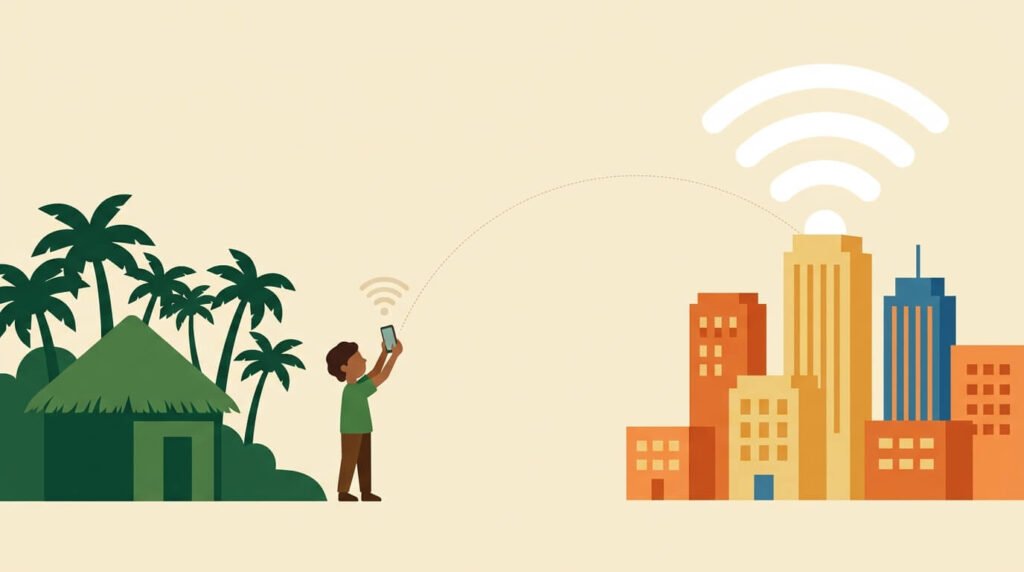
Rural communities in Nigeria have internet access at a rate of 23%, versus 57% in urban areas, according to NCC Executive Vice Chairman Dr. Aminu Maida, who disclosed the figures at the Rural Connectivity Summit in Lagos on October 22, 2025.
Speaking at the summit, Maida said, “A community without digital connectivity is functionally invisible, cut off from modern education, healthcare, markets, and opportunity.”
That statement was aimed directly at the gap between the two figures, not at the national average that usually gets quoted.
| Metric | Figure | Date |
|---|---|---|
| Rural internet access | 23% | October 2025 |
| Urban internet access | 57% | October 2025 |
| Rural-urban gap | 34 percentage points | October 2025 |
| National broadband penetration | 48.81% | October 2025 |
| National broadband penetration | 56.79% | June 2026 |
| Internet users nationally (unique users) | 45.5% of ~239 million population (109 million people) | October 2025 |
The national broadband penetration rate climbed by roughly eight percentage points between October 2025 and June 2026, which sounds like solid progress when reported alone.
But a national figure is a population-weighted average, and Nigeria’s population is concentrated in a relatively small number of large cities.
Urban growth can push the national number up substantially while rural access moves only slightly, because rural residents are a smaller share of the total population even though they occupy most of the country’s land area.
Anyone checking the internet penetration rate in Nigeria before deciding where to live should treat a single national percentage as describing cities first and rural areas as an afterthought.
Why rural areas lag on internet access
Rural Nigeria lags in internet access for reasons that are structural rather than incidental: the economics of building networks in low-density areas do not work without support, and the infrastructure that does get built is more exposed to fees, theft, and damage than urban infrastructure is.
The economics: low population density, high cost per site
A telecom tower or fiber run costs roughly the same to build whether it serves five thousand people packed into a few city blocks or five hundred people spread across a rural local government area.
In low-density regions, expanding mobile broadband networks becomes increasingly costly while revenue from each additional site declines, since fewer subscribers are available to recoup the investment.
A private operator deciding where to spend its next naira on network expansion will, absent a subsidy, choose the site with the fastest payback, and that site is rarely in a sparsely populated rural community.
This is the core reason rural coverage has moved more slowly than urban coverage even as national broadband subscriber numbers have grown.
Right-of-way fees and infrastructure vandalism
Historically, some state governments have charged high Right-of-Way (RoW) fees for permission to lay fiber cable or erect towers along roads, adding a fixed cost that falls hardest on projects with the thinnest margins, which are almost always the rural ones.
As of the data available in 2025, 11 states now offer zero RoW charges as an incentive to attract network buildout, a policy shift that helps but has not yet reached every state where rural gaps are widest.
Once infrastructure is in the ground, it faces damage that urban networks experience less severely because rural sites are harder to monitor.
“Between January and August 2025, Nigeria recorded 19,384 fibre‑cut incidents and 3,241 cases of equipment theft or vandalism, according to figures disclosed by the Nigerian Communications Commission (NCC) in October 2025.”
A fiber cut in a dense city is usually noticed and repaired within hours; the same cut on a rural route can take days to locate and fix, and the equipment stolen from an unguarded rural base station is rarely replaced quickly, if at all.
Add the cost of running diesel generators to power base stations that sit off the national grid, and the total cost of keeping rural service running, not just building it, climbs well above what many operators can justify without help.
None of the national or state-level figures above can tell you whether a specific compound or street in a rural or peri-urban area actually gets a usable signal once fiber cuts, right-of-way costs, and thin rural margins are factored in, which is exactly why Arandmi lets residents rate the real internet and power reliability where they live, street by street, before someone commits to an address.
What is being done to close the gap
Government intervention exists specifically because private operators, left alone, will not close the rural gap on commercial terms.
Two things are worth understanding: how the primary funding mechanism works, and what alternatives exist outside the traditional tower-and-fiber model.
USPF and the unserved-cluster funding gap
The Universal Service Provision Fund (USPF) is financed by mandatory contributions from telecom operators and is tasked with subsidizing network rollout in areas the market will not serve on its own.
It exists precisely because the economics described above mean operators cannot be expected to fund rural expansion out of ordinary revenue.
The scale of what remains unfunded is concrete. A 2022 study identified 97 unserved and underserved community clusters across Nigeria, representing an estimated 27.91 million people with no telecom access of any kind- not slow internet, but none at all.
That number has fallen over time: from 207 clusters in 2013, to 114 in 2019, to 97 in 2022, which shows real progress but at a pace measured in single digits of clusters per year rather than a wholesale closing of the gap.
Connecting the remaining 97 clusters is estimated to require around $461 million, a figure that puts a hard number on the funding shortfall behind the rural access statistics.
The National Broadband Plan set a target of 70% national broadband penetration by the end of 2025 and a separate goal of 96% mobile broadband coverage by 2030; both targets are behind schedule, and rural coverage is the main reason.
The economic case for closing this gap is not abstract either. A widely cited estimate holds that every 10-percentage-point rise in broadband penetration can lift GDP by up to 1.38%, and rural areas, being the least connected, are also where most of that untapped economic potential sits.
That connects directly to the pattern seen in the number of broadband subscribers in Nigeria: subscriber growth has been real, but it has been concentrated where infrastructure already existed.
Satellite and alternative access options
Satellite internet, particularly Starlink, has expanded in Nigeria since its 2023 launch and is increasingly used in areas without fiber or cell tower coverage, since it does not depend on ground infrastructure being built nearby.
For a household or small business in a rural area, satellite service can deliver a connection that would otherwise be years away under a tower-based rollout schedule.
The disadvantage is cost: satellite equipment and subscription fees remain considerably higher than typical mobile data plans, which puts it out of reach for many rural households even where it is technically available.
Community network initiatives, smaller, locally operated networks built with USPF or NGO support, are another route being tested in some underserved areas, though they remain far smaller in scale than what commercial operators or satellite providers can offer.
What the gap means if you are choosing where to live
If you are weighing a move to a rural or peri-urban area, the numbers above matter more than any national coverage map, because a map showing your state as “covered” can still mean a 23% chance that any given household nearby has usable internet.
National coverage figures and subscriber counts describe averages across an entire local government area or state; they say nothing about the specific street, compound, or estate you are considering.
Practical questions to ask before committing to a rural address include whether the area sits within a mapped USPF intervention zone, whether any operator has active fiber or tower infrastructure within a few kilometers, and whether satellite service is a realistic backup given the household budget.
None of these questions are answered by the national internet in Nigeria statistics that dominate most coverage of this topic; they require asking people who already live there.
Frequently asked questions
Why don’t rural areas in Nigeria have good internet?
Rural areas lag mainly because building and running networks in low-density regions costs about the same as in cities but generates far less revenue per site, which discourages private investment without a subsidy.
On top of that, some state governments have historically charged high Right-of-Way fees for infrastructure placement, and rural networks suffer disproportionately from fiber cuts, equipment theft, and vandalism because they are harder to monitor than urban sites.
High diesel costs for powering off-grid base stations add a further ongoing expense that urban sites, mostly connected to the grid, do not face.
Can satellite internet like Starlink fix the rural coverage gap in Nigeria?
Satellite internet, led by Starlink since its 2023 Nigerian launch, can bring service to rural locations without waiting for fiber or tower construction, which makes it a genuine option for some rural households and small businesses today.
Its limitation is cost: equipment and subscription prices remain well above what mobile data or fixed broadband typically costs, so it functions as a premium option rather than a mass-market fix for the 23% rural access rate.
Community network initiatives and continued USPF-funded tower and fiber projects remain necessary alongside satellite service, since neither approach alone is likely to close a gap of this size on its own.
3 Responses