
Mobile data and broadband are not the same thing in Nigeria, even though most people use the words interchangeably.
Mobile data means going online through a SIM card in a phone or a MiFi device, on MTN, Airtel, Glo, or 9mobile.
Broadband is a technical classification: only 3G, 4G, and 5G connections that meet the Nigerian Communications Commission’s minimum speed threshold count as broadband, whether that connection arrives over a SIM or through a fixed line into a building.
As of May 2026, Nigeria had 157,405,351 total internet subscribers, but only 121,643,718 broadband subscribers, a gap of roughly 35.8 million lines made up almost entirely of slower 2G connections.
For most households and small businesses, the real choice is between mobile data on a SIM and a fixed line such as fibre, fixed wireless, or satellite, and the right answer depends on cost, location, and how much data gets used.
What counts as broadband in Nigeria, and how it differs from mobile data
Broadband is defined by speed and technology, not by the device you use to connect.
A phone on 2G is online but not on broadband by the NCC’s definition, while the same phone on 4G qualifies.
This is why the NCC tracks two separate figures every month: total internet subscribers and total broadband subscribers, and why the second number is always smaller than the first.
Why the NCC tracks two different totals
The NCC’s May 2026 data put broadband penetration at 56.11 percent, rising to about 56.79 percent (roughly 123.11 million subscribers) by June 2026, up from 48.01 percent in July 2025.
That growth reflects operators upgrading customers from 2G to 4G rather than any meaningful shift toward fixed-line connections.
Anyone comparing figures across articles or reports should check whether a number refers to internet subscribers or broadband subscribers, since conflating the two overstates how many Nigerians have fast, reliable connections.
For a deeper look at how these categories break down nationally, see broadband subscriber growth nationally.
Mobile data in Nigeria: how most people get online
Mobile data is the default way Nigerians connect, by a wide margin.
Fixed-line connections are a rounding error next to the country’s mobile subscriber base, and the network technology mix confirms it: 4G accounts for 54.31 percent of connections nationally, 2G still holds 36.22 percent, 3G is down to 4.86 percent, and 5G sits at 4.61 percent.
The average subscriber used about 14.8GB per month by the first half of 2026, according to MTN’s own reporting, up 15.2 percent year on year, and total national monthly consumption reached 1,532,172.67 terabytes by June 2026.
Network technology and operator market share
| Operator | Subscriptions (June 2026) | Market share |
|---|---|---|
| MTN Nigeria | 98.64 million | 51.38% |
| Airtel | 66.12 million | 34.44% |
| Globacom | 23.68 million | 12.34% |
| 9mobile | 3.54 million | 1.84% |
MTN and Airtel together control more than 85 percent of the mobile market, which matters for coverage decisions because their tower footprints reach further into rural and semi-urban areas than the smaller operators.
Total active telecom subscriptions across all four networks reached 192.23 million by June 2026, a teledensity of 88.67 percent.
Fixed broadband in Nigeria: fibre, fixed wireless, and satellite
Fixed broadband means a dedicated line into a specific building rather than a signal shared across a cell tower’s coverage area.
It is far more capable than mobile data in raw capacity, but it barely exists outside a handful of cities.
Only about 265,000 homes nationally are connected via fibre-to-the-home as of 2026, despite Nigeria having built roughly 101,000 kilometers of fibre backbone infrastructure, most of which serves as long-haul transmission rather than last-mile connections into homes.
If you want the full picture of how that rollout is progressing, Nigeria’s fibre-to-the-home rollout covers it in detail.
The main fixed-line options available today include Spectranet, the largest dedicated fixed ISP with roughly 115,000 subscribers across fixed wireless and fibre.
Starlink, a satellite service offering 200-400 Mbps nationwide, including remote areas with no fibre or tower coverage nearby, costs around 57,000 naira a month plus about 590,000 naira for the hardware.
Tizeti, which serves more than 2.5 million users through solar-powered infrastructure with entry-level fibre plans around 15,000 to 25,000 naira a month; and ipNX, a premium fibre provider offering residential plans up to 1 Gbps, with a median measured speed around 37.78 Mbps.
MTN also runs its own fixed fibre product, FibreX, which added about 125,000 users over a year across 15 states and 232 locations, though 77.6 percent of those locations sit in Lagos, Rivers State, and the Federal Capital Territory alone.
Mobile data vs broadband: side-by-side comparison
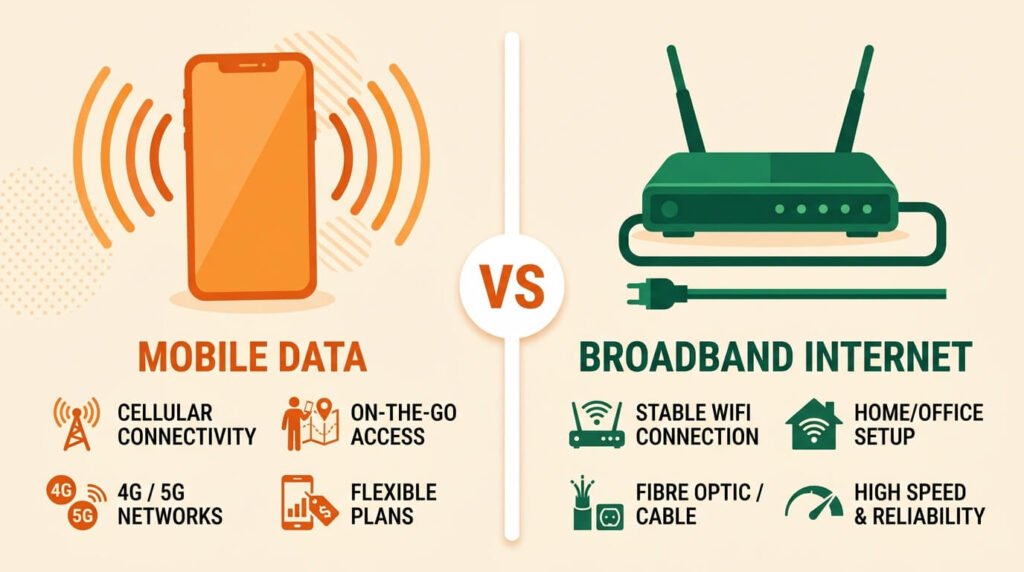
The two options trade off against each other on almost every dimension that matters to a household or small business. Neither is universally better; each wins on different criteria.
| Factor | Mobile data | Fixed broadband |
|---|---|---|
| Cost per GB | Higher per gigabyte at regulated rates, but shoppable bundle deals lower the effective price | Often cheaper per gigabyte at higher volumes, once available |
| Typical speed | Fluctuates with congestion, tower distance, and time of day | More consistent once installed, often symmetrical upload and download |
| Availability | Reaches the large majority of the population, including rural areas | Concentrated in pockets of Lagos, Rivers State, and the FCT |
| Reliability risk | Congestion and tower-level outages | Fibre cuts from construction and vandalism, but stable once connected |
| Setup | No installation; works anywhere there is signal | Requires installation and physical availability at the address |
| Best for | Individuals, single users, mobility, rural locations | Multiple simultaneous users, high sustained bandwidth, fixed locations |
Reliability is the factor most people underestimate on the fixed side. Nigeria recorded more than 27,685 fibre cut incidents nationally in 2025, with MTN alone recording 9,218 cuts, an average of over 25 a day, usually from road construction or vandalism rather than equipment failure.
Mobile networks avoid that specific failure mode but introduce their own, since congestion at peak hours and outages at a single base station can degrade service for everyone nearby.
Comparing plan prices between a network’s official coverage map and a fixed provider’s marketing page rarely tells you how either option performs on your actual street, which is exactly the gap Arandmi is built to close by letting residents rate real internet and power reliability address by address so you can see how mobile data and fixed broadband each hold up in a specific neighborhood before committing to one.
Cost Comparison: Mobile Data Pricing vs Fixed Broadband Pricing
The 2025 NCC-approved tariff hike, a 50 percent increase effective from February 2025, raised the regulated benchmark price of 1GB of mobile data from 287.50 naira to 431.25 naira.
Actual bundle prices vary well below that benchmark once you shop across plan sizes and operators; some consumers have found around 100GB for roughly 18,000 naira a month by picking the right bundle tier.
Fixed fibre entry-level plans from providers like Tizeti run roughly 15,000 to 25,000 naira a month, often for a much higher or effectively unlimited data threshold, which can make fixed broadband cheaper per gigabyte for a household that burns through large volumes of data every month, assuming the service is available at that address at all.
For a light user who just needs email, messaging, and occasional streaming, a mobile bundle is usually the more economical and more flexible choice regardless of location.
The national blended median internet speed sits around 33-37 Mbps, but that figure hides a wide spread.
A mobile connection in a congested part of Lagos at 8 pm can crawl well below that median, while a fixed fibre line like ipNX’s 1 Gbps residential tier delivers speeds far above it, consistently, because it is not shared with everyone in range of a single tower.
Which One Should You Choose?
The right choice depends on how many people share the connection, how much data they use, and whether fixed broadband is even physically available where you live.
A single professional working from a phone and laptop, moving between locations, or living outside a major city will almost always be better served by mobile data, since coverage reaches areas fixed fibre never will.
Rural areas have only about 23 percent internet access compared to 57 percent in urban areas, according to NCC Executive Vice Chairman Dr. Aminu Maida in October 2025, and mobile is effectively the only realistic option across most of that underserved rural stretch of the country.
A household with several people streaming, gaming, and video-calling at once, or a small business running point-of-sale systems and cloud tools throughout the day, benefits more from a fixed line if one is available, because it avoids the congestion that a shared mobile tower runs into during peak hours.
Before signing a fixed contract, confirm the provider serves your specific street rather than just the general local government area, since coverage maps tend to round up.
Before settling on mobile data as the fallback, check which operator has the strongest signal at your address rather than assuming national market share translates to local performance, since MTN’s 51.38 percent share nationally does not guarantee the best signal on every street.
Choosing between the two also means understanding where Nigeria’s connectivity numbers come from in the first place.
The full breakdown of how Nigeria connects covers the mobile-versus-fixed split at a national level, while how these figures fit into the national penetration rate explains what penetration percentages actually measure and why they keep climbing even in areas with patchy service.
Frequently Asked Questions
Which is cheaper, mobile data or fixed broadband in Nigeria?
It depends on how much data you use each month. Mobile data is generally cheaper for light to moderate use, especially after shopping across bundle sizes, since the regulated benchmark of 431.25 naira per gigabyte rarely reflects actual bundle pricing.
Fixed fibre plans starting around 15,000 to 25,000 naira a month often include a much larger or unlimited data allowance, which becomes more cost-efficient per gigabyte once a household’s usage climbs high enough, assuming a fixed connection is available at that address.
Why is fixed broadband not available everywhere in Nigeria?
Fixed broadband requires laying physical cable or fixed wireless equipment to each building, which is expensive and slow to expand compared to mobile towers that already cover wide areas.
Only about 265,000 homes nationally have fibre-to-the-home connections despite roughly 101,000 kilometers of fibre backbone existing in the country, because most of that backbone serves as long-distance transmission infrastructure rather than last-mile connections into individual homes.
Rollout has concentrated heavily in Lagos, Rivers State, and the Federal Capital Territory, leaving most other regions dependent on mobile networks.
Is mobile data or fixed broadband more reliable?
Each has a different failure pattern rather than one being uniformly more reliable.
Mobile data suffers from network congestion during peak hours and outages tied to individual cell towers, which affects everyone connected to that tower at once.
Fixed broadband depends on buried or overhead cable that gets physically cut, and Nigeria recorded more than 27,685 such fibre-cut incidents in 2025 alone, with MTN reporting over 9,218 of them.
Once a fixed connection is working, though, it tends to stay more stable and consistent than mobile data for sustained, high-bandwidth use.
2 Responses