
Prepaid billing means paying for electricity units before you use them, on a meter that shows exactly what’s left.
Estimated billing means no reading happened that cycle, so your DisCo assigns a figure from averages or area-wide consumption instead.
Most consumers frame this as “prepaid vs postpaid,” but Nigerian regulation cares about whether a reading occurred, not when you pay, and that decides which protections apply.
What is prepaid electricity billing?
Prepaid billing is pay-as-you-go. You buy units in advance from your DisCo or a licensed vendor, load them onto your meter with a token, and consume power until they run out.
There’s no monthly invoice to dispute, because the meter is the record.
How the prepaid meter token system works
- You pay your DisCo or a licensed vendor by app, USSD, or bank transfer, quoting your meter number.
- The vendor generates a token tied to that meter.
- You enter the token on the meter’s keypad.
- The meter converts the payment into kilowatt-hours and adds them to your balance.
- The meter counts down and alerts you when the balance runs low.
Every purchase includes a fixed service charge and VAT deducted before units are calculated, which is why the unit count rarely divides evenly by the price paid. See how to calculate your prepaid electricity cost.
What you pay for with a prepaid meter
Prepaid customers still pay Nigeria’s electricity tariff bands (Band A to E), which set the per-unit rate by how many hours of power your feeder delivers.
A prepaid meter doesn’t exempt you from the band system; you pay for what you’ve loaded, not last month’s usage.
| Band | Daily supply | Typical setting |
|---|---|---|
| Band A | 20+ hours | Urban feeders, premium rate |
| Band B | 16 to 20 hours | Mixed urban and suburban |
| Band C | 12 to 16 hours | Standard residential |
| Band D | 8 to 12 hours | Urban and rural |
| Band E | 4 to 8 hours | Urban and Rural, limited access |
What is estimated electricity billing?
Estimated billing happens when a DisCo can’t read your meter, or you don’t have one, so it assigns a monthly figure instead of billing actual consumption.
It’s a fallback status regulation treats as temporary and capped, not permanent.
Why you get an estimated bill instead of a meter reading
- You’ve never had a meter installed, despite requesting one.
- Your meter is faulty or was removed and not replaced.
- DisCo staff couldn’t access your compound, often because gates were locked.
- You’re a new customer waiting for a meter assignment.
- Illegal reconnections nearby distort the area’s expected revenue, and the shortfall spreads across unmetered accounts on the same line.
How DisCos calculate your estimated bill
- A transformer-level meter records total energy used across your feeder.
- The DisCo subtracts revenue already collected from prepaid customers on that transformer.
- The unaccounted-for remainder is treated as usage by unmetered customers.
- That deficit is divided among postpaid and unmetered accounts, adjusted for property type and past usage.
- Since 2020, the resulting figure is legally capped, not left to the DisCo’s discretion.
Two identical neighboring apartments can get very different estimated bills, since the figure reflects area-wide transformer readings, not conditions inside your walls.
Prepaid vs estimated billing: the real difference most electricity consumers get wrong
As we discussed in the beginning, most consumers think this is prepaid versus postpaid, as if paying before or after use is the only difference. It isn’t.
Postpaid assumes a meter exists and was read, even manually, before the invoice was cut. Estimated billing means no reading happened, whether there’s no meter, it’s broken, or nobody could get to it.
A customer can be “postpaid” on paper and still get billed on an estimate if their meter sits unread for months, so generic postpaid advice misses the protections that matter.
Estimated billing is not the same as postpaid billing
NERC draws this line explicitly. A meter read that cycle, even manually, means ordinary postpaid billing, no cap, since the figure is real.
A faulty or inaccessible meter falls under the three-month average rule. No meter at all falls under the capped, transformer-based methodology. Both count as “estimated” and carry legal ceilings a plain postpaid bill doesn’t.
Prepaid vs estimated billing: side-by-side comparison
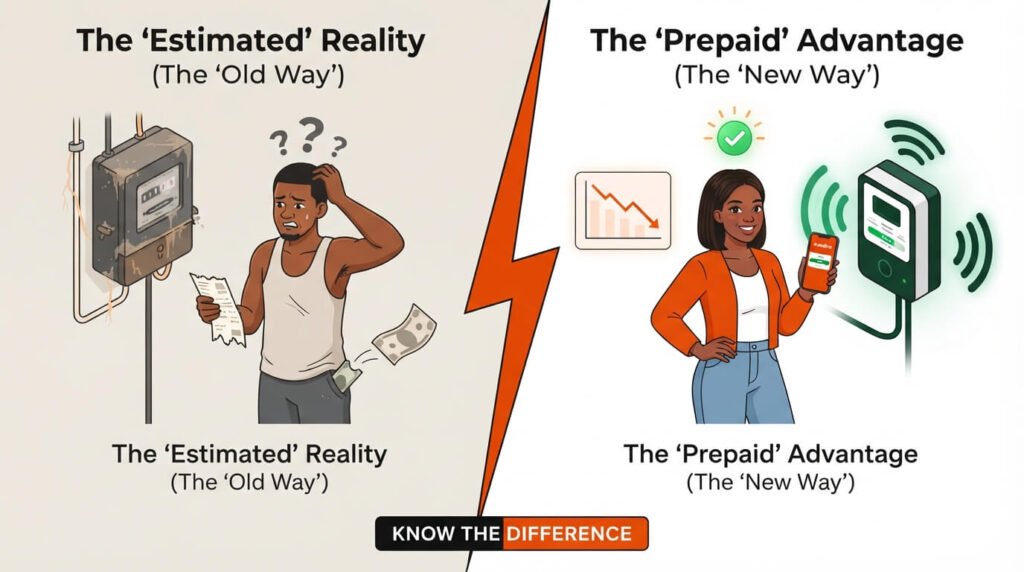
| Features | Prepaid billing | Estimated billing |
|---|---|---|
| When you pay | Before consumption | After an assigned figure |
| Basis for the amount | Units you load and use | Average usage or area-wide allocation |
| Requires a working meter | Yes | No, or one currently unread |
| Legal protection if overcharged | Rare, since you control what you load | Capping order and three-month rule apply |
| Risk of surprise bills | Low | High, especially where nearby theft is common |
Why estimated bills are often higher than prepaid bills
Estimated bills tend to run higher because they recover revenue a DisCo believes it’s owed across a whole feeder, and Nigeria’s metering gap is large enough to spread that shortfall across millions of accounts.
The revenue shortfall and electricity theft problem
When a transformer-level meter shows more electricity leaving than the DisCo can attribute to paying customers, someone nearby is using power without paying, often through illegal reconnection, and unmetered accounts absorb the cost.
As of April 2026, approximately 5.02 million Nigerian electricity customers remain on estimated billing, while 7.44 million customers have been metered, according to data from the Nigerian Electricity Regulatory Commission (NERC). This represents a national metering rate of 59.69% across 12.46 million active electricity customers.
“The Federal Government announced in August 2026 that it has metered approximately 60 percent of active electricity customers, with 668,000 meters installed under Phase 1 of the $500 million World Bank-financed Distribution Sector Recovery Programme (DISREP). However, over 5 million customers remain on estimated billing as of April 2026, despite ongoing National Mass Metering Programme efforts and the World Bank facility, which was approved in 2023 and launched in February 2026.”
The NERC capping order and your legal bill ceiling
Since November 2020, NERC’s capping order has set a legal ceiling for unmetered customers, tied to what metered customers on the same feeder pay.
Suppose your last three verified bills averaged ₦18,000 a month; under the three-month rule, this month’s bill can’t jump to ₦45,000 without documented reason.
That gap is what the order exists to catch: grounds for a dispute. Read the NERC capping order on estimated bills for the full text.
| Situation | Applicable rule | What it means for your bill |
|---|---|---|
| No meter installed | 2020 Capping Order | Can’t exceed the published cap for your feeder |
| Meter faulty or removed | Three-month average rule | Should reflect your last three verified readings |
| New connection, no meter yet | 2012 Methodology Regulations | Should follow documented method, not a guess |
Your rights under Nigerian electricity regulation
Two regulatory instruments govern how an estimated bill gets calculated, and knowing their names turns a vague complaint into a citable one.
The Methodology for Estimated Billing Regulations 2012
This is NERC’s original rule requiring a documented method, not guesswork, for billing unmetered or unread customers.
It predates the 2020 capping order and still governs the calculation; that later order added the enforceable ceiling on top.
The three-month average rule for faulty or missing meters
Where a working meter existed recently but is now faulty, removed, or inaccessible, NERC requires billing on the average of your last three verified months of billing or vending, not a fresh guess.
Once a replacement meter records real readings, this rule should stop applying.
How to get a prepaid meter and stop estimated billing
A working prepaid meter removes you from the estimated billing pool entirely, since it bills only what you load, the most durable fix available.
Free metering options: NMMP, MAP, and DISREP
| Program | What it offers | Cost | Typical wait |
|---|---|---|---|
| National Mass Metering Programme (NMMP) | Government-funded rollout through DisCos | Free | Varies by DisCo |
| Meter Asset Provider (MAP) scheme | Faster installation through licensed providers | Paid, sometimes in installments | Usually weeks |
| DISREP franchise metering | Third-party operators meter franchise areas | Usually free, operator-funded | Depends on rollout |
Applying for a meter from your DisCo
- Confirm your account number and meter status with your DisCo.
- Submit a meter application online or in person.
- Provide proof of address and your latest estimated bill; some DisCos use it to prioritize applicants.
- Ask whether you qualify for the free NMMP allocation before agreeing to the paid MAP route.
- Follow up in writing if you hear nothing within the quoted timeframe; undocumented applications are easy to lose.
How to challenge or dispute an unfair estimated bill
You have a formal, cost-free path through NERC if your DisCo won’t correct a wrong bill, and using it correctly matters more than complaining.
The NERC complaint process
Filing a formal NERC complaint follows five stages.
- Lodge a written complaint with your DisCo’s Customer Complaints Unit and keep the reference number.
- Wait fifteen working days; if unresolved, escalate through NERC’s online portal with your bill attached.
- Follow up by email if the portal complaint goes unanswered.
- NERC’s Forum Office schedules a hearing, usually within forty-five days, and can order a refund or fix.
- If unsatisfied, escalate to the State High Court, though NERC’s process must be tried first.
What to do if your DisCo ignores your complaint
- Check your DisCo’s official complaint contacts to confirm you used the right unit; misdirected complaints often explain silence.
- Re-file through NERC’s portal instead of repeating the same email, since the fifteen-day clock triggers escalation.
- Keep every reference number, date, and reply in one file, as proof of prior attempts.
- Bring in a lawyer only after NERC’s process stalls, since courts expect that route first.
Getting off estimated billing means doing two things at once: pushing for a meter through the NMMP or MAP route, and disputing any bill that ignores the capping order.
If your bill looks inflated, file the complaint now rather than waiting for a meter, since both run in parallel.
Frequently asked questions
Is prepaid or estimated billing cheaper in Nigeria?
Prepaid billing is typically cheaper in practice, not because the tariff differs, but because you only pay for units you actually load and use.
Estimated billing often folds in a share of a transformer area’s unrecovered consumption, including electricity lost to theft nearby.
Two households in the same band can pay noticeably different amounts, even at an identical rate.
Why does my estimated bill not match my actual usage?
Your estimated bill isn’t calculated from your usage at all. It comes from what your transformer or feeder recorded for the whole area, minus what paying prepaid customers already covered.
If neighbors have illegal connections or bypassed meters, that gap lands on accounts like yours, which is why the three-month rule and the 2020 capping order exist: to keep that allocation from becoming unlimited.
Can I be disconnected for refusing to pay an estimated bill?
Refusing to pay any bill, including a disputed one, can lead to disconnection, so pay under protest while filing a formal complaint rather than withholding payment.
NERC’s dispute process doesn’t require you to stop paying to have a claim heard, and disconnection during an active, documented complaint is grounds to raise with the Forum Office.
Keep proof you filed before any disconnection happens.
How do I know if my DisCo is billing me above the NERC cap?
Compare your current estimated bill to the average of your last three verified bills from before it became estimated.
If the new figure is significantly higher with no written explanation, such as a tariff band change or documented consumption increase, it likely exceeds what the three-month rule and the 2020 capping order permit.
That gap is documentable grounds for a complaint, not just a sense that the bill “feels high.”
If your bill looks wrong, don’t wait it out. Start your NERC complaint today and push for a prepaid meter in parallel, so you stop paying for power that was never yours.