
A prepaid electricity meter runs on tokens you buy and load in advance, cutting power once the credit runs out, while a postpaid meter records your usage and sends you a bill after the fact, once someone reads it.
That single distinction, pay first versus pay later, shapes almost everything else about how the two devices feel to live with: how you budget, how disputes happen, and how much control you have over your own power supply.
If you are choosing a meter, or trying to make sense of the one already on your wall, understanding the mechanics of each one matters more than any generic “prepaid is better” advice you will find online.
How a prepaid electricity meter works
A prepaid electricity meter works by deducting units of electricity from a stored balance as you consume power, and it stops supplying electricity once that balance hits zero.
There is no bill waiting for you at the end of the month, because you have already paid before you used the power.
Nearly every prepaid meter installed by Nigerian distribution companies today runs on a system called STS, which standardizes how the token you buy talks to the meter on your wall.
The STS token system explained
STS stands for Standard Transfer Specification, an international standard that Nigerian DisCos adopted so that tokens generated by any licensed vendor will work on any STS-compliant meter.
When you buy credit, whether through your DisCo’s app, a bank transfer platform, or a USSD code, the system generates a unique 20-digit token tied to your meter’s serial number.
That token is encrypted, so it cannot be reused on a different meter or duplicated once it has been entered. The meter itself decodes the token, adds the corresponding units to your balance, and updates its internal register.
This is also why keeping track of your meter’s identity matters. If you ever need to buy a token, request a repair, or file a complaint with your DisCo, you will need to check your prepaid meter number first, since vendors and support lines use it to confirm the token was generated for the right device.
How to load a token into your meter
- Purchase a token from your DisCo’s official app, website, or an approved vendor, using your correct meter number.
- Wait for the 20-digit code to arrive by SMS, email, or on-screen confirmation.
- On your meter’s keypad, enter the digits exactly as received and press the Enter key.
- Confirm the meter display shows “accepted” or a similar success message along with your new unit balance.
- If the token is rejected, double-check for transposed digits before contacting your vendor, since each token can normally only be entered once.
How a postpaid electricity meter works
A postpaid electricity meter works by continuously recording how much electricity a household uses, without ever cutting supply on its own, and the DisCo bills the customer afterward based on that recorded consumption.
Nothing about the meter itself limits your usage in real time. Instead, it accumulates a running total, similar to how a water meter or a landline phone line used to work, and someone has to read that total before a bill can be produced.
Manual reading vs automated meter reading
Most postpaid meters in Nigeria are still read manually. A DisCo staff member visits the property, notes the figures on the meter’s display, and logs them for billing.
The alternative, automated meter reading, uses a communication module inside the meter to send consumption data back to the DisCo remotely, without anyone entering the compound.
Automated reading shows up more in newer digital meters and select commercial or high-usage accounts, but it is not yet the norm for residential postpaid meters, so many households still depend on a physical visit happening on schedule.
The billing cycle, from reading to payment
Once a reading is taken, the DisCo calculates the units consumed since the last reading, applies the customer’s tariff band, and adds any standing charges or levies before issuing a bill, typically on a monthly cycle.
The customer then has a set window to pay before penalties or the risk of disconnection apply.
Because pricing on a postpaid meter still depends on the household’s assigned band, it is worth taking a moment to check your electricity band, so you know which tariff rate is actually being applied to your consumption each cycle.
Prepaid vs postpaid: the real day-to-day differences
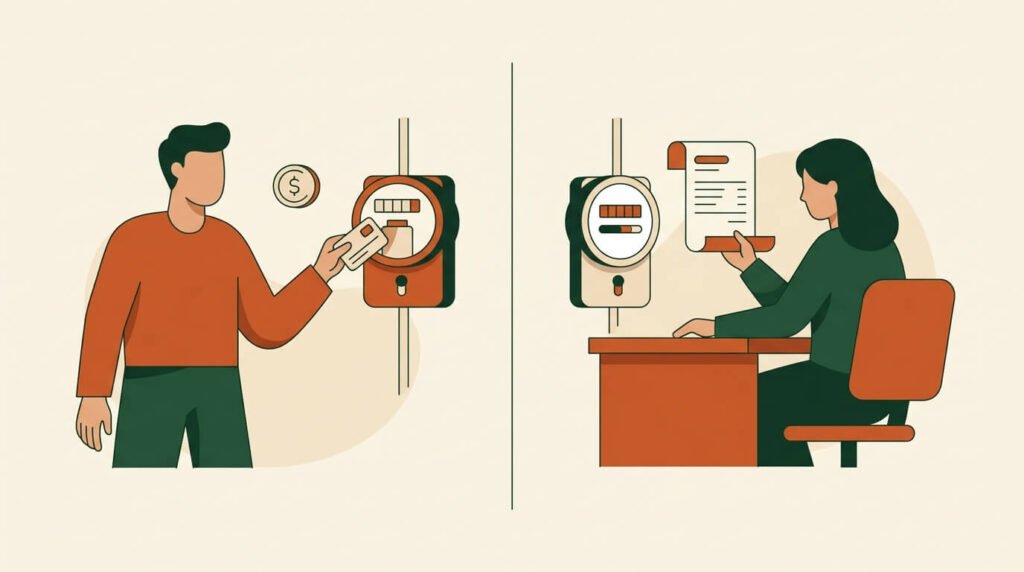
The two meter types diverge most in daily practice, not in the electricity itself, since both deliver the same power from the same grid.
What changes is who controls the timing of payment and how much visibility you have into your own usage.
| Attribute | Prepaid meter | Postpaid meter |
|---|---|---|
| Payment timing | Pay before use, top up anytime | Pay after use, on a monthly cycle |
| Budgeting control | High, you see your balance shrink in real time | Lower, consumption is only visible after billing |
| Risk of surprise bills | Very low, since you cannot use more than you have paid for | Higher, since usage and cost are only confirmed later |
| Disconnection method | Automatic when balance hits zero | Manual disconnection after unpaid bills |
| Dispute risk | Rare, since usage is self-metered in real time | More common, tied to reading errors or estimation |
| Upfront cost | Meter cost paid once at installation (often through MAP) | Often installed by the DisCo with billing starting later |
| Best suited for | Renters, tenants, anyone wanting tight budget control | Property owners with a stable relationship with their DisCo |
Arandmi exists for the part of this decision that a meter type alone cannot solve: how reliable the power actually is where you are thinking of living.
Before you commit to a new area, you can see how residents there rate power stability and internet reliability, street by street, which tells you far more about daily life than the billing method on the meter alone.
The estimated billing risk with postpaid meters
The estimated billing risk with postpaid meters comes from missed readings, not from the meter type itself, since a postpaid meter that is read accurately every cycle works exactly as designed.
The problem arises when a staff member cannot access the property, the reading schedule slips, or the account falls through the cracks for a cycle or longer.
When that happens, the DisCo issues a bill based on an estimate of past usage, and that estimate can run higher or lower than what was really consumed. This is a narrower issue than people often assume, and it deserves its own explanation rather than a quick mention here.
The full picture of how estimated billing works and what your rights are as a customer is covered in a separate article on this site.
Which meter does NERC’s metering programs actually install?
NERC’s current metering programs, the Meter Asset Provider scheme and the National Mass Metering Programme, both center on closing Nigeria’s prepaid metering gap, not on expanding postpaid installations.
Under the Meter Asset Provider scheme, a customer pays a MAP company upfront for a prepaid meter and gets it installed within roughly ten working days, with the cost recovered gradually through energy credits.
If you want to skip an indefinite wait for a DisCo-issued meter, going through the Meter Asset Provider (MAP) scheme is currently the fastest legitimate route to getting a prepaid meter installed.
The National Mass Metering Programme, funded through government and Central Bank support, has similarly focused on distributing prepaid meters to unmetered customers, rolled out in phases as funding allows.
Neither initiative is built around postpaid meters, which reflects a broader policy push toward self-metered, pay-as-you-go supply.
Can you convert a postpaid meter to prepaid?
Yes, a postpaid meter can be converted to prepaid, but it requires a physical meter swap rather than a settings change, since the two run on different hardware.
To convert, you apply through your DisCo or a licensed Meter Asset Provider, clear any outstanding balance on the postpaid account, and have a technician install a new STS-compliant unit in place of the old meter.
This can happen quickly through a paid MAP application, or take longer if you are waiting on a free rollout under a government scheme. Once installed, the account switches entirely to the token-based system, and the old billing history is closed out.
Understanding how your meter works is one part of settling into a new home.
The other part, whether the power actually stays on and whether the internet in that neighborhood holds up, is something a meter alone cannot tell you, which naturally leads to a few common questions people ask when they are comparing meter types before making that decision.
Frequently asked questions
What is an STS prepaid meter?
An STS prepaid meter is a meter built to the Standard Transfer Specification, an international protocol that lets any licensed vendor’s token work correctly on the device.
It decodes an encrypted 20-digit code entered on its keypad, credits the corresponding electricity units to your balance, and deducts from that balance as you consume power.
STS is the standard used across nearly all prepaid meters installed by Nigerian DisCos and MAP companies today, which is why tokens bought through different apps or USSD codes still work on the same physical meter.
Is a prepaid meter cheaper than a postpaid meter?
Neither meter type changes the actual price of electricity, since both are billed at the same tariff rate for a given customer band.
What differs is the payment structure: a prepaid meter requires an upfront cost for the device itself, often recovered gradually if installed through the MAP scheme, while a postpaid meter is typically installed by the DisCo with billing starting only after a reading is taken.
Many households find prepaid cheaper in practice simply because it prevents the accumulation of large, unexpected bills.
Who reads a postpaid meter and how often?
A postpaid meter is normally read by a DisCo staff member who visits the property in person, and this typically happens on a monthly cycle to match the billing schedule.
Some newer digital meters support automated meter reading, where consumption data is transmitted electronically without a physical visit, but this remains less common on residential postpaid accounts than manual reading.
When a scheduled visit is missed, the DisCo may issue an estimated bill for that cycle instead of waiting for the next reading.
Are smart meters in Nigeria prepaid or postpaid?
Most smart or digital meters currently being deployed in Nigeria are configured as prepaid, using the STS token system, since NERC’s active metering programs are focused on expanding prepaid coverage rather than postpaid.
A smart meter can technically support either billing model depending on how the DisCo configures it, but in practice the rollout under schemes like MAP and the National Mass Metering Programme has centered almost entirely on prepaid units.
Choosing between meter types comes down to how much control you want over your own electricity spending and how confident you are in your DisCo’s reading schedule.
A prepaid meter puts that control directly in your hands, while a postpaid meter depends on a process working correctly behind the scenes.