
The NERC capping order, issued in November 2020, sets a legal ceiling on what a Nigerian electricity distribution company can charge a customer who doesn’t have a working meter.
It ties that ceiling to what metered customers on the same feeder already pay, so a DisCo can’t simply assign whatever figure covers its revenue shortfall.
If your estimated bill has no documented reason behind a sudden jump, the order is what makes that jump challengeable.
What is the NERC capping order?
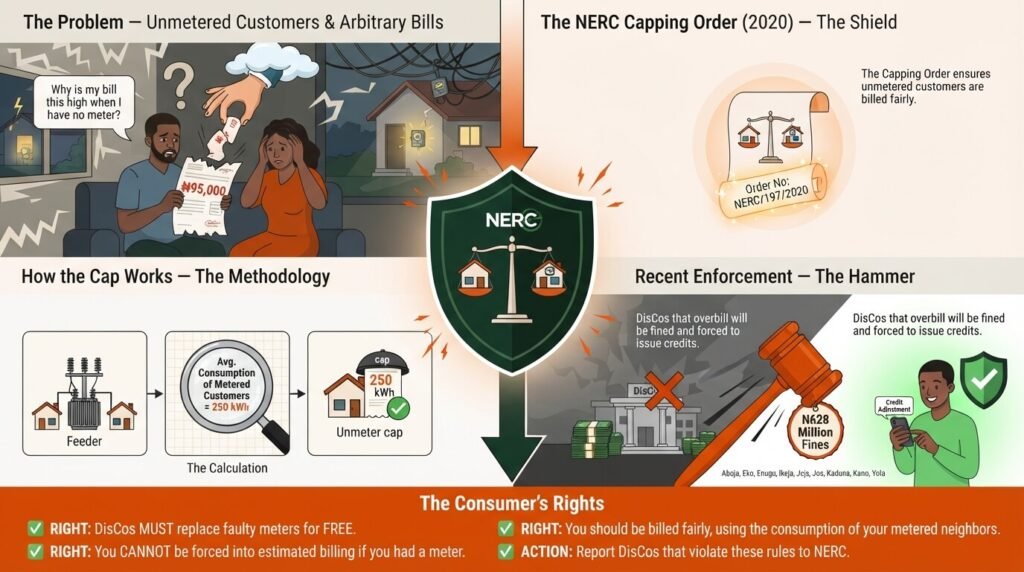
It’s a regulatory instrument from the Nigerian Electricity Regulatory Commission that caps how much unmetered or unread customers can be billed, based on actual consumption data from metered customers in the same area rather than a DisCo’s own estimate.
Why NERC introduced the capping order in 2020
Before the order, DisCos had wide discretion in how they distributed unrecovered revenue across unmetered accounts, and complaints of inflated estimated bills were common enough that NERC stepped in with a fixed formula tied to verifiable data.
The order didn’t ban estimated billing outright, since millions of Nigerians still lack meters, but it removed the guesswork DisCos previously relied on.
Which customers the order protects
Anyone without a working meter, whether they’ve never had one installed, had one removed, or are waiting on a new connection, falls under this protection.
It also extends to customers whose meter is technically present but faulty or inaccessible for reading, since their account effectively reverts to an estimate until the meter is fixed.
How the cap is calculated
NERC uses two distinct methods depending on whether a customer ever had a working meter, and knowing which one applies to you changes what a fair bill looks like.
The three-month average rule
- Applies to customers whose meter recently worked but is now faulty, removed, or physically inaccessible.
- Your bill should reflect the average of your last three verified months of billing or vending, not a fresh guess by the DisCo.
- Once a replacement meter is installed and recording real readings, this rule stops applying, and your bill reverts to actual consumption.
- Any bill significantly above that three-month average, without a written explanation such as a tariff band change, is a candidate for dispute.
The transformer-based methodology for unmetered customers
For customers who’ve never had a meter, NERC’s methodology starts at the transformer or feeder level.
A dedicated meter records total energy delivered to that feeder, the DisCo subtracts what its metered prepaid customers already paid for, and the unaccounted-for remainder is distributed among the unmetered accounts on that line, adjusted for property type and past consumption patterns.
The 2020 order caps how large that distributed remainder can be relative to what comparable metered customers pay, so it can’t simply absorb an area’s entire revenue gap, including losses from illegal connections nearby.
The capping order vs the 2012 Methodology Regulations
These two rules work together rather than replacing each other, and mixing them up is a common reason people misjudge whether their bill is actually out of line.
| Features | 2012 Methodology Regulations | 2020 Capping Order |
|---|---|---|
| What it requires | A documented, consistent method for calculating estimated bills | A legal ceiling on the resulting figure |
| What it doesn’t do | Set a maximum amount | Replace the underlying calculation method |
| Applies to | All unmetered or unread customers | Same group, as an additional protection layer |
| What it means for you | Your bill must follow a real formula, not a guess | That formula’s output can’t exceed the published cap |
Real-world example: what capping looks like on a bill
Say your last three verified bills, from before your meter stopped being read, averaged ₦18,000 a month.
Under the three-month rule, this month’s estimated bill should sit close to that figure unless something documented has changed.
- Your DisCo issues a bill for ₦45,000 with no accompanying explanation.
- You check whether your tariff band changed or your household added new appliances; neither applies.
- The jump from ₦18,000 to ₦45,000 has no basis in either the three-month average rule or a transformer-level calculation you can verify.
- This gap is exactly what the capping order exists to catch, and it gives you documented grounds to dispute the bill rather than simply feeling it’s too high.
A bill that stays reasonably close to your verified average, even if it’s slightly higher, is harder to successfully dispute, since some monthly variance is expected. It’s the unexplained, large jump that the order targets.
What to do if your DisCo ignores the cap
Filing a dispute means going through NERC’s process in order, since skipping straight to a lawyer or the courts before exhausting NERC’s channel usually gets you sent back to start over.
Filing a complaint step by step
- Lodge a written complaint with your DisCo’s Customer Complaints Unit, referencing the capping order and your three-month average, and keep the reference number.
- Wait fifteen working days for a response.
- If unresolved, escalate through NERC’s online portal with your billing history attached.
- NERC’s Forum Office typically schedules a hearing within forty-five days and can order a refund or a corrected bill.
- If you remain unsatisfied, escalation to the State High Court is available, though NERC’s process must be tried first.
If your DisCo’s complaints unit doesn’t respond within that window, confirm you’re using your DisCo’s official complaint contacts before assuming NERC’s process has failed you, since a good number of stalled complaints trace back to a wrong department rather than genuine inaction.
Before you file anything, it helps to know exactly what you should be paying in the first place.
Work through how to calculate your prepaid electricity cost, so you’re comparing your estimated bill against a real number, not just a feeling that it’s too high, and read the full breakdown of the real difference between prepaid and estimated electricity billing in Nigeria if you’re still deciding which billing type actually applies to your account.
Frequently asked questions
What exactly does the NERC capping order limit?
It limits how much a DisCo can bill an unmetered or unread customer relative to what metered customers on the same feeder actually pay, preventing the DisCo from assigning an unlimited share of its revenue shortfall to individual accounts.
The cap applies on top of the underlying calculation method set out in the 2012 Methodology Regulations, so both the method and the ceiling have to hold at once. A bill that follows neither is doubly disputable.
How do I know if my estimated bill exceeds the cap?
Compare your current bill to the average of your last three verified bills from before your account became estimated, since that average is the benchmark the three-month rule is built around.
If the new figure is significantly higher with no documented explanation, such as a tariff band change or a confirmed rise in consumption, it likely exceeds what the rule and the capping order together permit.
That comparison, kept in writing, is what turns a complaint from a feeling into evidence.
Does the capping order apply if I’ve never had a meter installed at all?
Yes, but through the transformer-based methodology rather than the three-month average rule, since there’s no personal billing history to average.
NERC still caps how much of a feeder’s unrecovered revenue can be distributed to unmetered accounts on it, so an unusually high bill in this situation is disputable too, though verifying it requires transformer-level data rather than your own past bills.
Your DisCo’s Customer Complaints Unit is required to explain the calculation if asked.
Can NERC’s capping order get me a refund if I’ve already paid an inflated bill?
Yes, if NERC’s Forum Office finds your bill exceeded what the capping order and the underlying methodology allow, it can order a refund or credit against future bills, not just a correction going forward.
This is why keeping proof of payment alongside your complaint reference number matters, since a resolved dispute without payment records is harder to convert into an actual refund.
File the complaint as soon as you notice the discrepancy rather than waiting for a pattern to build.
If your bill doesn’t reflect either of NERC’s approved methods, don’t treat it as final. File a written complaint referencing the capping order today, and keep every reference number until it’s resolved.
Billing disputes are easier to win when you already know what reliable power looks like in your area, and that’s information other residents can give you before you ever sign a lease.
Arandmi lets residents rate the power and internet where they live, so the next person house-hunting in that neighborhood knows before they commit rather than finding out after a string of inflated bills.
Create a free account and rate your own area; it takes a few minutes and helps someone else make a better housing decision.