
Nigeria’s electricity bands (A through E) set how much you pay per kilowatt-hour based on how many hours of power your area is supposed to receive each day, and most customers who think they know their band have never checked it against what they’re actually being billed.
The Nigerian Electricity Regulatory Commission (NERC) built the system to tie tariffs to service quality, but the assignment isn’t based on your house, meter, or usage.
It’s based on a shared power line called a feeder, and the rules for reclassifying that feeder are specific and enforceable, yet rarely used by the customers they protect.
What Are Nigeria’s Electricity Bands?
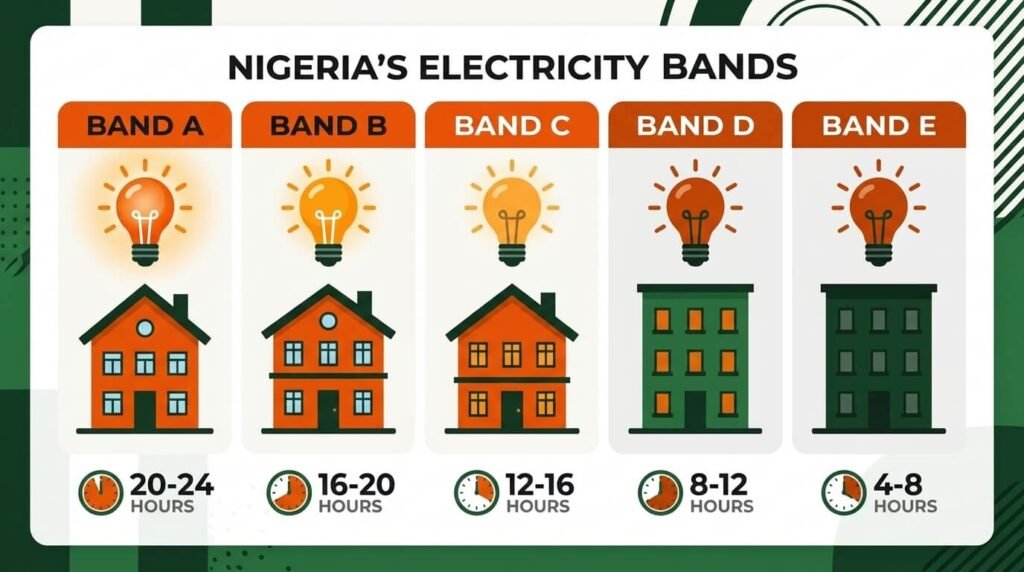
An electricity band is a category NERC assigns to a group of customers based on the average hours of power their feeder delivers each day.
There are five bands, A through E, each carrying a different tariff. Band A pays the most because it’s supposed to get the most hours of supply; Band E pays the least because it gets the fewest.
This system is called the Service-Based Tariff, or SBT, and it replaced a flat-rate model where customers paid roughly the same regardless of how much power actually reached their homes.
A customer with four hours of electricity a day shouldn’t pay the same rate as one with twenty.
Band A to Band E: Supply Hours and Definitions
| Band | Daily Supply Hours | Who It’s For |
|---|---|---|
| Band A | 20 to 24 hours | Highest-tariff, highest-reliability feeders |
| Band B | 16 to 20 hours | Above-average supply |
| Band C | 12 to 16 hours | Moderate supply |
| Band D | 8 to 12 hours | Below-average supply |
| Band E | 4 to 8 hours | Lowest-tariff, least reliable feeders |
What Is the Service-Based Tariff?
NERC introduced the Service-Based Tariff on November 1, 2020, requiring DisCos to set tariffs according to hours of electricity actually delivered rather than a flat national rate.
The policy gives distribution companies a financial incentive to improve supply, since better service lets a feeder move to a higher, more profitable band, and worse service forces a downgrade.
Current Electricity Band Tariffs in 2026
Under the NERC-approved Multi-Year Tariff Order in effect through 2026, Band A customers pay the highest rate in the country, while Bands C, D, and E share a lower, subsidized rate.
These figures come from NERC’s national order, though individual DisCos can publish slight variations for their own franchise areas.
| Band | National NERC Rate (per kWh) |
|---|---|
| Band A | ₦225 |
| Band B | ₦62–66/kWh |
| Band C | ₦50–54/kWh |
| Band D | ₦36–48/kWh |
| Band E | ₦36–48/kWh |
Band A Tariff Rate
Band A jumped from ₦66 to ₦225 per kWh in April 2024, a 240.9 percent increase that NERC said was needed to cut the government’s electricity subsidy by roughly ₦1.14 trillion for the year.
Not every DisCo charges the full national rate. Ikeja Electric, for example, lowered its own Band A rate to ₦206.80 per kWh starting May 6, 2024, a reminder that your specific DisCo’s published rate can differ from the national baseline.
Band B, C, D, and E Tariff Rates
Bands B through E remain considerably cheaper and, according to NERC, still partly subsidized. Band B sits around ₦63 per kWh, while Bands C, D, and E are grouped near ₦50.
These lower bands haven’t seen the sharp increase Band A got in 2024, though a 2025 proposal floated raising rates further, from ₦116.18 to ₦193.63 per kWh, as part of a broader plan to phase out subsidies.
Rates are reviewed periodically, so check your DisCo’s published schedule directly rather than relying on a figure that could be a year old. For the full timeline since 2017, see our full history of Nigeria’s electricity tariff increases.
How Your Electricity Band Is Actually Assigned
Your electricity band isn’t tied to your meter, your house, or your payment history.
It’s tied to the feeder that supplies your neighborhood, and it changes automatically based on that feeder’s measured performance, whether or not any individual customer has complained.
The Feeder Concept: Why It’s Not About Your House
A feeder is a major distribution line that runs from a substation and branches out to supply an entire area, often thousands of homes and businesses at once.
NERC requires DisCos to monitor average voltage hours on each feeder because power can’t be separated by individual meter until it reaches the final transformer near your property.
Two houses on the same street, but different feeders, can genuinely sit in different bands and pay different rates, and one unreliable transformer upstream can drag an entire neighborhood’s tariff down.
The 7-Day Downgrade and 14-Day Upgrade Rules
NERC’s order sets specific, dated thresholds for reclassifying a feeder, and these are the mechanisms most customers never invoke.
- If a Band A feeder misses the minimum 20 hours of supply for two consecutive days, the DisCo must publish an explanation on its website and notify affected customers by SMS by 10:00 a.m. the next day.
- If the DisCo misses the committed service level for seven consecutive days, the feeder is automatically downgraded to the level of supply it actually delivered.
- If the shortfall is smaller, averaging below 20 hours over a full month but not persistent enough to trigger a downgrade, the DisCo must issue free energy units as compensation instead.
- A feeder can only move up to a higher band, such as from B to A, after sustaining that higher service level for 14 consecutive days.
NERC enforces this in practice. In its May 2025 Supplementary Order, the Commission directed eight DisCos to downgrade 18 underperforming Band A feeders and ordered compensation across 213 more feeders that had fallen short.
How to Check Your Electricity Band
The fastest way to confirm your band is to check your DisCo’s online customer portal with your meter or account number, since most band disputes start with a customer noticing their bill doesn’t match the hours of power they’re actually getting.
You can also check which DisCo and band covers your address if you’re unsure which of Nigeria’s eleven DisCos serves your area.
Checking Your Band by DisCo
| DisCo | States Served | How to Check |
|---|---|---|
| Ikeja Electric | Lagos | Visit ikejaelectric.com, go to Customer Service, then Feeder Verification, and enter your account or meter number |
| Eko Electricity | Lagos | Check your DisCo portal or contact customer care with your account number |
| Abuja (AEDC) | FCT, Kogi, Nasarawa, Niger | Check your DisCo portal or contact customer care with your account number |
| Ibadan (IBEDC) | Kwara, Ogun, Osun, Oyo | Check your DisCo portal or contact customer care with your account number |
| Port Harcourt (PHED) | Akwa Ibom, Bayelsa, Cross River, Rivers | Check your DisCo portal or contact customer care with your account number |
| Enugu (EEDC) | Abia, Anambra, Ebonyi, Enugu, Imo | Check your DisCo portal or contact customer care with your account number |
Checking Your Band From Your Bill or Prepaid Token Receipt
If you’d rather skip the portal, your monthly bill or prepaid meter token receipt usually lists your current band and tariff rate directly.
This is often the quickest confirmation, since it reflects exactly what you’re being charged rather than a classification that may lag behind a recent downgrade or upgrade.
What to Do If You’re Being Overcharged for Your Band
If you’re paying Band A rates but consistently getting fewer than 20 hours of power a day, you have a specific, documented complaint process, not an informal request for goodwill.
Keep a written log of your daily supply hours for at least two weeks before filing, since that log turns a vague complaint into evidence.
How to File a Complaint With Your DisCo
- Record your daily supply hours for a minimum of two weeks, noting the times power was on and off.
- Contact your DisCo’s customer care line or visit a physical office with your account or meter number and your supply log.
- Formally request a review of your band classification, referencing the specific dates and hours in your log.
- Ask for the outcome in writing, whether that’s a reclassification, a credit, or a stated timeline for resolution.
How to Escalate to NERC and What Compensation Looks Like
- If your DisCo does not resolve the complaint within 30 days, file a formal escalation with NERC, including your original complaint reference and your supply log.
- NERC evaluates disputed feeder performance over a defined monitoring period before ordering a remedy.
- Remedies can include automatic downgrade of the feeder to match its real performance, free energy unit credits for the shortfall period, or a formal DisCo directive to fix the underlying fault.
- Real cases follow this pattern: one Lagos customer who submitted a two-week outage log showing 8 to 10 hours of daily supply, despite being billed at Band A rates, was reclassified to Band C and credited ₦12,000 in energy units as compensation.
For a template you can adapt when filing your own complaint, see our NERC billing complaint letter template.
Band A vs. Generator Power: Is the Higher Tariff Worth It?
Band A electricity, even at ₦225 per kWh, is still far cheaper than running a generator, which is the real comparison most Nigerian households are making when they weigh whether fighting for a band upgrade is worth the effort.
That’s why we built Arandmi to help you know which areas in Nigeria get reliable power so you can make a quality decision either when renting an apartment or for business.
Generator fuel costs typically land between ₦600 and ₦900 per kWh once you factor in petrol or diesel prices and maintenance, meaning even Nigeria’s most expensive grid tariff is a fraction of the cost of self-generated power.
Cost Per kWh: Grid vs. Generator
| Power Source | Approximate Cost per kWh |
|---|---|
| Band A (grid) | ₦206.80 to ₦225 |
| Band B (grid) | ₦63 |
| Bands C, D, E (grid) | ₦50 |
| Petrol generator | ₦1100 to ₦1400 ( depending on the state) |
| Diesel generator | ₦1600 to ₦1950 |
Use our generator running cost calculator to work out what your own setup actually costs per month before deciding whether pursuing a band upgrade makes financial sense.
When Band A Genuinely Saves You Money
A household that actually receives its full 20 to 24 hours of Band A supply can run most appliances off the grid and reserve the generator for a few hours a day, cutting fuel spending sharply compared to running a generator most of the day on a lower band.
The savings only show up if the DisCo genuinely delivers those hours. A household billed at Band A rates while receiving Band D-level service is paying premium prices for a service it isn’t getting, which is exactly the scenario the complaint process above is meant to fix.
Unmetered Customers and Estimated Billing Under the Band System
Unmetered customers can still be billed under a band classification, even without a meter to confirm actual usage, which is one of the more contested parts of the current system.
Because estimated billing relies on projected consumption rather than a verified reading, a customer without a meter has less evidence to point to if they suspect their band assignment is wrong.
How Estimated Billing Interacts With Bands
NERC’s capping order limits how much unmetered customers can be charged relative to metered customers in the same band, in an attempt to prevent estimated bills from running far ahead of actual consumption.
In practice, more than seven million registered customers, over half of the country’s registered base, remained unmetered as of NERC’s Q3 2024 report, and metering and billing complaints together accounted for the majority of all complaints DisCos received that quarter.
To understand exactly how these two systems differ and interact, read our breakdown of the difference between prepaid and estimated billing.
Your Rights If You’re Still Unmetered
- You have the right to request a meter and have one installed under NERC’s Meter Asset Provider scheme, without paying the full cost upfront.
- You have the right to dispute an estimated bill that doesn’t reflect a documented change in your usage.
- You have the right to file a complaint with NERC if your DisCo delays or refuses a reasonable meter request.
- You have the right to a billing dispute resolution within 30 days of filing a formal complaint.
If you’re still waiting on a meter, our guide to how the Meter Asset Provider (MAP) scheme works walks through how to request one and what to do if your DisCo stalls.
Knowing your band is the first step. Acting on a mismatch between what you’re billed and what you actually receive is what gets it fixed, and the tools above, from checking your DisCo portal to filing a documented complaint, are what NERC’s own rules already give you the right to use.
Frequently Asked Questions About Nigeria’s Electricity Bands
What is Band A electricity in Nigeria?
Band A is the highest electricity classification in Nigeria’s Service-Based Tariff system, covering feeders that deliver 20 to 24 hours of power daily.
Customers on Band A pay the highest tariff in the country, currently around ₦225 per kWh under the national NERC rate, though some DisCos, such as Ikeja Electric or PHED in some areas in Port Harcourt like Nvuigwe in Woji, charge a slightly lower rate for their own Band A customers.
The classification applies to the feeder supplying your area rather than to your individual meter or house.
How do I find out what band I’m on?
You can check your electricity band through your DisCo’s online customer portal by entering your account or meter number, or by looking directly at your monthly bill or prepaid token receipt, both of which usually list your current band and tariff rate.
If you’re unsure which DisCo serves your area, contacting their customer care line with your account details is the most reliable fallback.
In-person verification at a DisCo office is also an option if the online portal isn’t working.
What happens if my DisCo doesn’t deliver my band’s promised hours?
If a feeder fails to meet its committed supply hours for seven consecutive days, NERC’s rules require an automatic downgrade to a lower band matching the actual service delivered.
Smaller, non-persistent shortfalls instead trigger compensation in the form of free energy units credited to affected customers’ next bill.
If your DisCo doesn’t act on either remedy, you can escalate the complaint directly to NERC after documenting your actual supply hours for at least two weeks.
Is it true unmetered customers can be billed as Band A?
Yes, unmetered customers can be billed under any band classification, including Band A, based on the feeder serving their area rather than a confirmed meter reading.
NERC’s capping order is meant to limit how far an estimated bill can run ahead of likely actual usage, but without a meter, customers have less direct evidence if they suspect they’re being overcharged.
Requesting a meter through NERC’s Meter Asset Provider scheme is the most reliable way to resolve this uncertainty.
3 Responses