
The real cost of running a generator in Nigeria comes down to one formula: liters burned per hour, multiplied by hours run, multiplied by the current pump price.
A small petrol generator running a few hours a night costs a few thousand naira a day. A diesel genset carrying a shop or small estate for ten or twelve hours climbs into tens of thousands.
Most guides stop at “generators are expensive.” This one works the actual numbers by size, gives a genuine cost-per-kWh figure, and sets that beside what grid electricity costs so you can see the real gap.
How to calculate your generator’s running cost
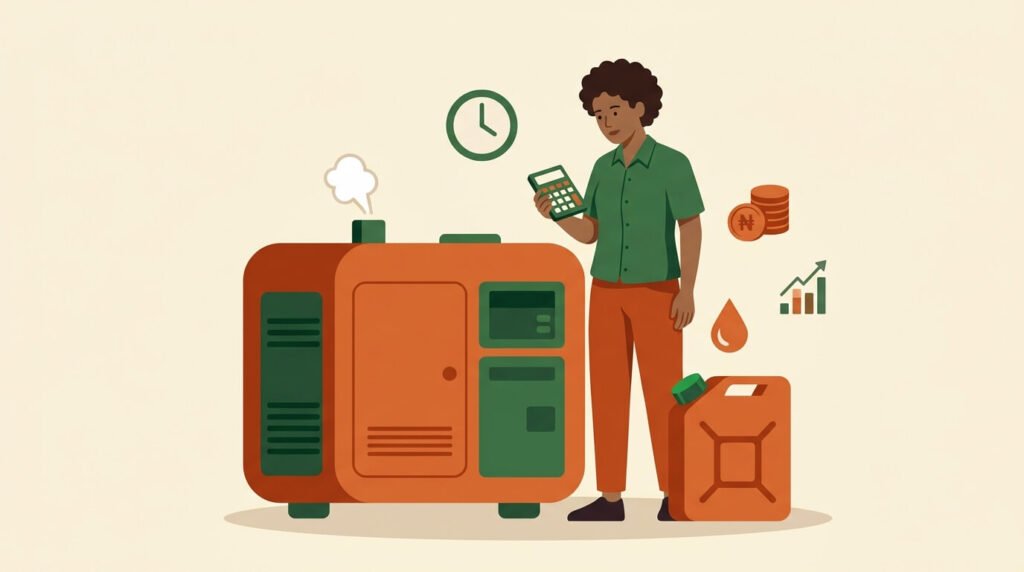
Your generator’s daily running cost is the product of three numbers you can pin down yourself: fuel burned per hour, hours run, and price per liter at the pump. Once you have those three, the rest is arithmetic.
The basic formula
Daily fuel cost = liters per hour x hours run x price per liter.
A 2.5kVA petrol generator burning roughly 0.9 liters an hour, run for 6 hours at 1,400 naira a liter, costs 0.9 x 6 x 1,400, or 7,560 naira for the day, about 226,800 naira a month before anything else is added.
What the formula leaves out
- Load matters more than the nameplate rating, since running a fridge and a few bulbs uses less fuel per hour than running an air conditioner or a pumping motor.
- Idle time still burns fuel, so a generator left running while nobody draws much power wastes money without you noticing.
- The formula covers fuel only. Servicing, oil, and wear add a real amount on top, which the maintenance section below puts a number on.
Fuel consumption by generator size
Fuel consumption per hour rises with generator size, but not in a straight line, and the sizes Nigerian households and small businesses actually buy cluster into a few clear bands.
The table below uses moderate, realistic loads rather than a generator’s maximum rated output, since almost nobody runs a genset flat out for hours at a stretch.
| Generator size | Fuel type | Consumption (L/hr) | Typical daily hours | Cost per day | Approx. cost per kWh |
|---|---|---|---|---|---|
| 1 to 1.3kVA (“I better pass my neighbor” type) | Petrol | 0.5 | 4 | N2,800 | N1,000 |
| 2.5 to 3.5kVA | Petrol | 0.9 | 6 | N7,560 | N630 |
| 5kVA | Petrol | 1.6 | 8 | N17,920 | N640 |
| 7.5 to 10kVA | Diesel | 2.2 | 10 | N39,600 | N609 |
| 15kVA | Diesel | 2.6 | 12 | N56,160 | N468 |
| 25 to 30kVA | Diesel | 5.0 | 12 | N108,000 | N450 |
Figures assume petrol at roughly 1,400 naira a liter, diesel at roughly 1,800 naira a liter, and usable output of around 70 to 80 percent of the kVA rating once power factor and typical loading are accounted for.
Your own numbers will shift with fuel prices, load, and how well the generator is maintained.
Small petrol generators, 1 to 3.5kVA
These are the units most renters and small households buy first, and they are the least efficient per unit of electricity delivered.
A 1 to 1.3kVA “I better pass my neighbor” generator running a few lights, a fan, and phone charging costs around 2,800 naira a day at 4 hours of use, which works out to roughly 1,000 naira per kWh, several times what any grid tariff band charges.
A 2.5 to 3.5kVA unit improves the picture somewhat, but small petrol generators stay the most expensive way to keep the lights on per unit of power produced.
Mid-size and larger diesel generators, 5kVA and up
Once you move into 5kVA petrol units and 7.5kVA-plus diesel gensets, bigger engines convert fuel to usable power more efficiently.
A 15kVA diesel generator running 12 hours a day costs more in absolute naira than a small petrol set, since it burns more fuel overall, but its cost per kWh drops to roughly half of what the smallest petrol units charge.
This is why a shared generator for a block of flats often makes more financial sense per household than everyone running individual small units.
Current fuel prices in Nigeria and how they move your cost
Fuel prices in Nigeria move often enough that any figure here is a snapshot, not a fixed number. As of early September 2026, petrol (PMS) has been selling for roughly 1,285 to 1,330 naira a liter in Lagos and Ogun States, running higher elsewhere, sometimes 1,650 to 1,800 naira a liter.
Diesel (AGO) has been trading around 1,800 naira a liter, up from about 1,600 naira just days earlier, after wholesale gantry price increases from major refiners.
Check the current pump price in your state before committing to a monthly generator budget, and rerun the formula above with today’s number rather than last month’s.
Generator cost per kWh versus grid electricity
Converting generator running cost into naira per kWh is the only way to compare it fairly against the grid, since size, fuel type, and hours run vary too much for a naira-per-day comparison to mean much.
As the table above shows, small petrol generators can cost 600 to 1,000 naira or more per kWh, while larger diesel units bring that down to the 450 to 650 naira range.
Grid electricity, by contrast, currently runs from roughly 160 naira per kWh up to around 230 naira per kWh for Band A customers, depending on your distribution company, with lower bands charging less but delivering fewer guaranteed hours of supply.
That gap is the whole economic case for wanting reliable grid power in the first place, and it is worth taking the time to check your electricity band before assuming a generator is your cheaper option, since a strong Band A or Band B connection can cost a fraction of what backup fuel does per unit of electricity.
Knowing an area’s real grid reliability before you move in helps you budget for how much generator backup you will actually need, instead of guessing after you have already signed a lease.
Arandmi lets residents rate the power and internet reliability where they live, so a house hunter can see what an area’s supply actually looks like before committing.
Maintenance, servicing, and depreciation: the cost fuel alone won’t show you
Fuel is the biggest line item, but skipping maintenance to save money now usually costs more later through breakdowns and shorter engine life.
- Oil changes are typically needed every 50 to 100 hours of running time, costing roughly 5,000 to 15,000 naira depending on generator size and oil type.
- Spark plugs, filters, and general servicing for small petrol units can add another 10,000 to 25,000 naira a year for a household running its generator regularly.
- Larger diesel gensets need more involved servicing, including injector checks and coolant maintenance, which can run into tens of thousands of naira per interval.
- Depreciation is easy to ignore, but a generator run hard for years loses value, and replacing it eventually is part of the true cost of owning one.
A reasonable rule of thumb is to add 10 to 20 percent on top of your calculated fuel cost to approximate the full running cost once maintenance and wear are included.
Why more Nigerian households lean on generators as tariffs rise
Generator dependence in Nigeria has grown alongside rising grid electricity costs, not despite them, since households that once tolerated outages now see backup power as insurance against paying more for less reliable supply.
The history of Nigeria’s electricity tariff increases explains why so many households run generators even where grid connections exist. For a house hunter, a neighborhood’s grid reliability and tariff band together set your realistic monthly power budget, not just the connection itself.
Before you settle on a monthly power budget for a new area, it helps to see how the math above answers a few of the questions people ask most often about running a generator day to day.
Frequently asked questions
How many liters of fuel does a generator use per hour?
It depends on size and load, but a small 1 to 3.5kVA petrol generator typically burns 0.5 to 1 liter an hour, a 5kVA unit burns around 1.5 to 2 liters an hour, and diesel gensets from 7.5kVA upward burn roughly 2 to 5 liters an hour at moderate load.
Consumption rises with load, so a unit running an air conditioner or pumping motor burns noticeably more fuel than one running lights and a fan.
Is diesel or petrol cheaper to run a generator in Nigeria?
Diesel generators are usually cheaper per unit of electricity produced even though diesel costs more per liter than petrol, because diesel engines convert fuel to power more efficiently and tend to come in larger, more efficient size classes.
A small petrol generator can cost 600 to 1,000 naira or more per kWh.
In comparison, a larger diesel unit often lands between 450 and 650 naira per kWh, which is why businesses running generators for many hours a day usually choose diesel once the load justifies it.
Is it cheaper to run a generator or use grid electricity in Nigeria?
Grid electricity is almost always cheaper per kWh than a generator, since even Band A tariffs, the highest grid rate, sit well below what any generator size costs per unit of electricity produced.
The catch is reliability rather than price: a generator guarantees power when you need it, while grid supply depends on your band and your distribution company’s actual performance, which is why many households budget for both.
How often should I service a generator and how much does that add to the cost?
Most generators need an oil change every 50 to 100 hours of use, along with periodic filter and spark plug replacement for petrol units or more involved servicing for diesel gensets, and skipping this schedule shortens the generator’s life and raises fuel use over time.
Budgeting an extra 10 to 20 percent on top of your fuel cost accounts for maintenance, oil, and the gradual wear every running generator accumulates.
Whatever size you land on, rerunning this formula with your own hours and today’s fuel price gives a far more accurate monthly figure than any generic estimate, worth doing before, not after, you commit to a new home or backup setup.