
Most people who sign a lease in Nigeria without checking power and internet find out the truth in the first week: the “24-hour light” the agent promised is six hours on a good day, and the “strong network” barely holds a WhatsApp call.
Checking power supply and internet quality before renting in Nigeria decides your monthly budget and whether the rent you agreed on is actually cheap once fuel and data are added.
Nigeria’s tariff reform now ties what you pay per unit to your hours of power, and internet quality still varies street to street.
Skipping the check risks paying premium rates for a service you never receive.
Why Power Supply Matters Before You Sign a Lease in Nigeria
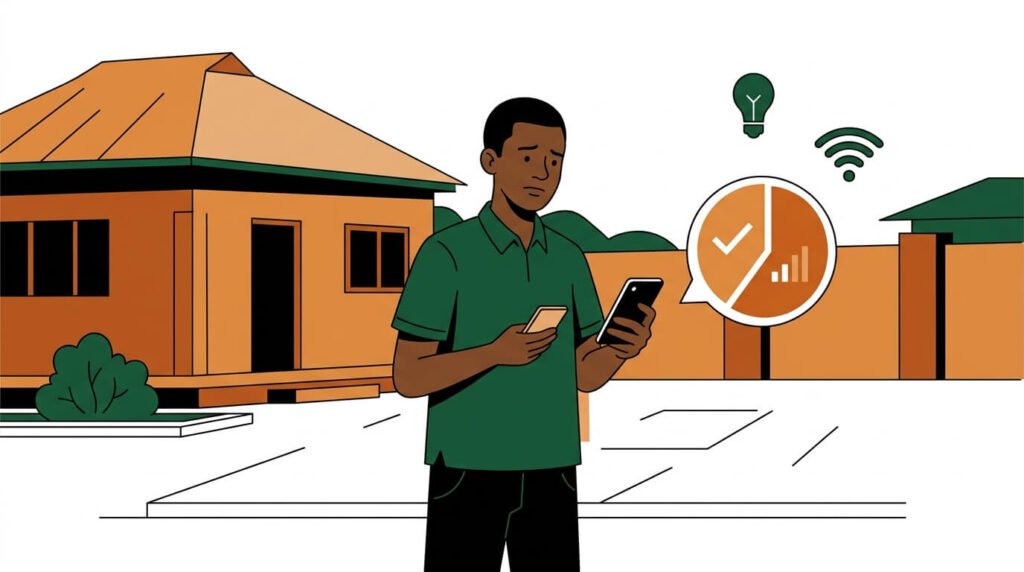
Checking power supply before renting means confirming three things: the electricity band, whether the meter is prepaid or postpaid, and what backup power already exists.
An agent saying “we have light” answers none of these and tells you nothing about your actual bill or comfort.
What “Checking Power Supply” Actually Means
- Band is the classification (A through E) DisCos use to set the tariff and required hours of supply.
- Meter type determines whether you pay for real usage or inherit a monthly estimate, where most disputes start.
- Backup power covers whether the building has a shared generator or solar, and who pays for fuel.
The Real Cost of Ignoring Power Supply Before Renting
- You may pay Band A rates for power delivered at Band D reliability, with no way to prove it later.
- You may inherit a previous tenant’s unpaid debt the moment your prepaid meter starts drawing down.
- You may end up paying for diesel or petrol weekly on top of “cheap” rent.
How to Check Electricity Band and Meter Type Before Renting
Confirming the band and meter type takes about ten minutes, and none of it should involve taking the agent’s word for it.
How to Confirm the DisCo Band (A to E) at That Address
- Ask the current tenant for a recent prepaid token receipt. The tariff rate on it reveals the band: roughly ₦209 to ₦241 per kWh means Band A, while ₦50 to ₦70 per kWh means Band D or E.
- Cross-check that rate against your DisCo’s band listing, since a whole estate is not always on one band.
- Ask about the transformer serving the building, not just the estate name. Two houses on the same road can sit on different feeders, one running 20 hours a day while the other manages eight.
- Check real resident ratings for that address before relying on anyone’s word, since long-term residents report patterns an agent has no reason to disclose.
Prepaid vs Postpaid Meter: What to Ask the Landlord
| Question | Prepaid Meter | Postpaid Meter |
|---|---|---|
| How is usage measured? | Units bought in advance, used as consumed | Estimated or read after the fact |
| Risk of inherited debt | Old debt can be deducted from your first top-up | Old bills can be passed to the new occupant |
| Billing accuracy | Reflects real consumption | Often estimate-based, despite NERC limits |
| Request before signing | A clean token receipt with no debt | Last three months of bills, marked settled |
How to Avoid Inheriting Old Electricity Debt
- Ask to see the meter’s payment history, not just its balance.
- Confirm with the DisCo directly, not only the landlord, that no debt is tied to that meter.
- Put responsibility for prior debt in writing in the tenancy agreement.
Why Internet Access Must Be Checked Before Renting an Apartment
Checking internet before renting means testing what actually reaches that address, not what a coverage map claims. Maps show theoretical reach; they say nothing about whether your floor gets a usable signal indoors.
What “Checking Internet” Means Beyond “Is There Network Here?”
A provider having towers “in the area” differs from delivering a stable, indoor signal at your exact address. Ground floor, top floor, and which side of the building faces the street can each get a different result.
Who Needs to Verify Internet Most: Remote Workers vs Everyday Users
- Everyday users mostly need enough signal for calls, streaming, and browsing without buffering.
- Remote workers need a connection that survives video calls, since a dropped client call has a direct cost.
- Anyone earning online income should treat reliability as a business requirement and budget for backup.
How to Check Internet Network Coverage Before Renting in Nigeria
Verifying internet takes more effort than checking power, since speed results change by time of day and by floor.
Step-by-Step: Verifying Internet at the Exact Address
- Ask a current tenant for a live speed test inside the unit, not at the compound gate.
- Test again after 6 p.m., since evening congestion peaks and a connection fine at noon can crawl by 9 p.m.
- Ask which network current occupants actually use, since the best SIM in that building is rarely the one marketed as best nationally.
- Check resident reviews for that street on which provider holds up after dark.
Fibre vs LTE vs Satellite (Starlink): Which Fits Your Rental
| Type | Strength | Weakness | Best Fit |
|---|---|---|---|
| Fibre | Fast, stable, weather-proof | Limited to wired streets | Long-term renters with heavy remote work needs |
| LTE (mobile router) | Widely available, easy setup | Slows under evening congestion | Renters needing flexibility or short leases |
| Satellite (Starlink) | Works where fibre and LTE fail | High hardware cost, real monthly fee | Renters in poorly served areas needing backup |
The True Monthly Cost of Power and Internet When Renting in Nigeria
The cheapest rent on paper is often the most expensive apartment once you add power and internet.
A lower rent in a Band E area with unreliable network can cost more monthly than higher rent in a Band A, fibre-covered building.
Sample Cost Breakdown: Cheap Rent, Poor Power vs Higher Rent, Band A/Fibre
| Cost Item | Scenario A: Low Rent, Band E | Scenario B: Higher Rent, Band A |
|---|---|---|
| Monthly rent (est.) | ₦150,000 (est) for one room | ₦220,000 |
| Electricity tariff | ~₦60/kWh, 6 to 8 hrs/day | ~₦225/kWh, 20+ hrs/day |
| Generator fuel | ₦50,000 to ₦60,000/month | ₦0 to ₦5,000/month |
| Internet | ₦15,000/month, unstable LTE | ₦30,000/month, stable fibre |
| Estimated total | ₦200,000 to ₦225,000+ | ₦245,000 to ₦250,000 |
Hidden Costs Agents Rarely Mention
- Generator maintenance and parts add tens of thousands of naira a year that never comes up upfront.
- Shared generators sometimes split fuel costs evenly regardless of actual usage per unit.
- A weak indoor signal often pushes tenants toward a second SIM, quietly doubling the data bill.
Best Areas and Estates Known for Stable Power and Internet in Nigeria
No neighbourhood name guarantees stable power or internet, because reliability is decided at the transformer and building level, not the estate’s reputation.
Even a well-regarded area contains streets that underperform, which is why the steps above matter even in a “good” area.
What to Look For in an Estate Beyond Its Location
- Estate management that handles generator fuel and maintenance collectively, not each tenant on their own.
- Multiple internet providers nearby, since one provider going down should mean no internet at all.
- A visible pattern of long-term tenants, which usually signals no exodus over power or network complaints.
City-by-City Snapshot: Lagos, Abuja, Port Harcourt
| City | General Pattern | What Still Varies Street-to-Street |
|---|---|---|
| Lagos | Mixed; Band A pockets in Lekki, Ikoyi, Victoria Island | Transformer load and estate management quality |
| Abuja | Relatively better supply in GRAs and newer districts | Two streets in the same district can differ sharply |
| Port Harcourt | Industrial areas often report steadier supply | Residential streets near industrial zones vary widely |
The fastest way to shortcut this guesswork is to see what people already living on that street are saying.
Arandmi is a free, crowdsourced platform where Nigerians rate power and internet quality in their neighbourhood, including daily hours of light and which network holds up after dark.
Before taking an agent’s word for it, search real resident ratings for that area.
Frequently Asked Questions
How do I know if an apartment has good electricity supply in Nigeria?
Ask for the current occupant’s electricity band and a recent prepaid token receipt before relying on what the agent tells you.
The tariff rate on that receipt reveals the band, and the band tells you what you will pay per unit and how many hours of supply the DisCo must deliver.
Cross-check that against resident reports for the specific street, since supply can differ from one building to the next within a single estate, and ask about the transformer serving that side of the road.
What is Band A electricity in Nigeria?
Band A is the highest electricity classification under Nigeria’s Service-Based Tariff system, covering customers whose DisCo commits to at least 20 hours of supply a day.
Band A customers pay a higher tariff, roughly ₦209 to ₦241 per kWh depending on the DisCo, compared with ₦50 to ₦70 per kWh for lower bands.
If a DisCo consistently fails to deliver at least 90 percent of the promised hours, customers are entitled to compensation or reclassification under NERC’s rules.
Can a new tenant be forced to pay a previous tenant’s electricity bill?
No tenant should be liable for a prior occupant’s unpaid electricity debt, though this happens often when the meter’s history goes unchecked before move-in.
Prepaid meters can carry old debt that deducts from a new tenant’s first top-up, while postpaid accounts can arrive with unresolved balances the landlord never disclosed.
Request the meter’s payment history from the DisCo, confirm no balance is attached to that meter, and put responsibility for prior debt in writing in the tenancy agreement.
How do I check internet network coverage before renting an apartment in Nigeria?
Ask a current tenant to run a live speed test inside the unit, not at the compound entrance, and repeat it after 6 p.m., when evening congestion is heaviest.
A coverage map only shows theoretical reach; it says nothing about signal strength on a specific floor.
Ask which network current residents actually use, since the strongest option in one building is rarely the one marketed as strongest nationwide.
Checking power and internet before renting takes an hour at most, and that hour decides your monthly budget for as long as you stay.
Rate your own area on Arandmi once you move in, so the next renter gets an honest answer instead of an agent’s guess.