Independence Layout
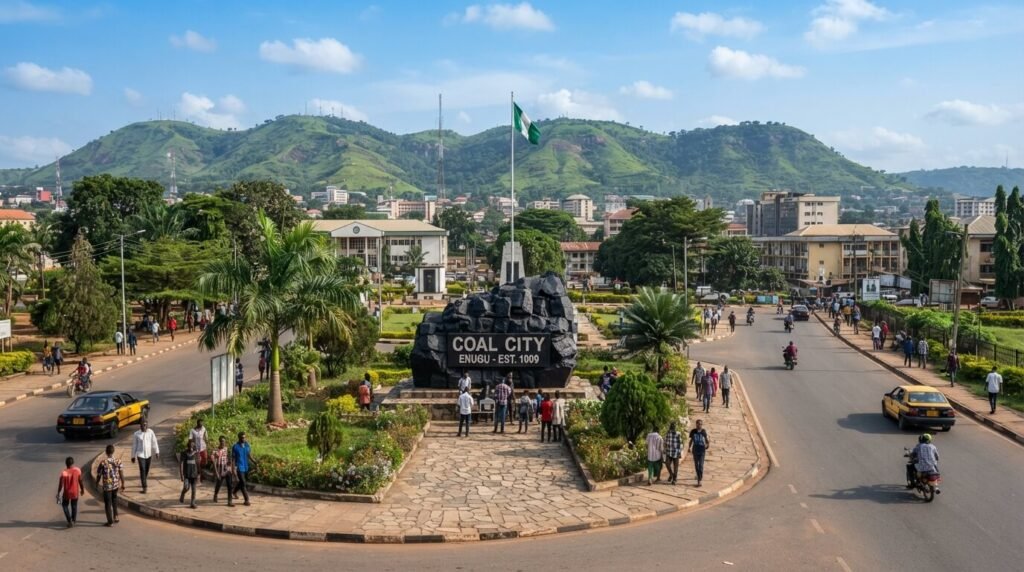
A planned residential layout in eastern Enugu, largely low-density housing.

Enugu State lies in Nigeria’s southeast, with Enugu city as its capital. It was created on 27 August 1991, separated out from Anambra State.
The state borders Benue and Kogi to the north, Ebonyi to the east and southeast, Abia to the south, and Anambra to the west.
Most residents are Igbo, though pockets of Idoma, Hausa, Yoruba, and Igala live in parts of the state near its northern border.
Trading and services make up a large share of the local economy, alongside farming, with yams, rice, cocoyam, oil palm, and cassava grown widely. Coal mining once defined the region, especially around the Udi Hills near the capital, and gave the city its name, which comes from the Igbo phrase for hilltop.
The Udi-Nsukka Plateau rises across the state’s northern half, and the Ekulu River and Nike Lake give the capital some of its greenery. Enugu also carries heavy historical weight as the wartime capital of the short lived Republic of Biafra during the Nigerian Civil War.
Actor Chiwetel Ejiofor traces his family back to Enugu, as does former Senate President Ken Nnamani, current governor Peter Mbah, footballer Maduka Okoye, and horror novelist Nuzo Onoh.
A planned residential layout in eastern Enugu, largely low-density housing.